

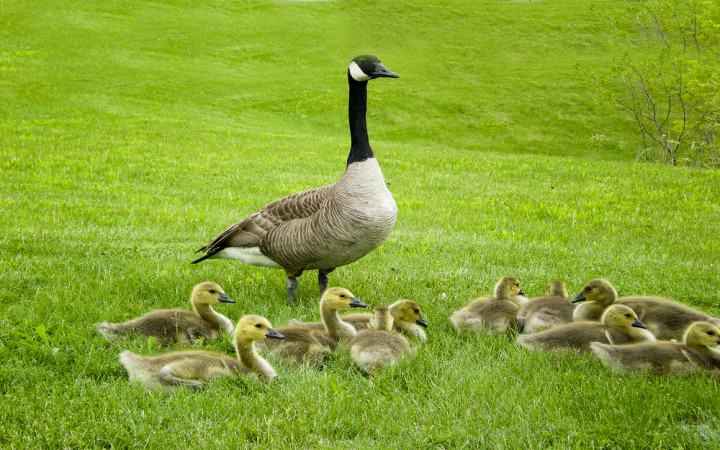
Do you have any favorite nursery rhymes? We do! We love “Hey Diddle Diddle” and “Hot Cross Buns.” Have you ever heard “Humpty Dumpty”? How about “Ring Around the Rosie”? If so, you probably already know a bit about the topic of today’s Wonder of the Day. It’s Mother Goose!
Lots of kids think Mother Goose is pretty great. And why wouldn’t they? She’s an important part of many popular children’s poems. This leads some people to WONDER—is Mother Goose a fictional character? Or is she based on a real person?
If you ever visit Boston, Massachusetts, you may hear that Mother Goose was indeed a real person. Some believe she lived there in the 1660s. They say she was either named Elizabeth Goose or Mary Goose.
Legend has it that this woman cared for 16 children. She loved to sing songs and create rhyming stories for them. This was certainly a common practice at the time. Many women sang rhyming songs to their children to help them sleep. That’s why they’re called nursery rhymes!
However, there’s no proof that Mother Goose was a real person. Still, many fairy tales and nursery rhymes are credited to her. A few examples are “Jack and Jill,” “Little Miss Muffet,” and “Hickory Dickory Dock.” She also appears as the title character in one rhyme:
“Old Mother Goose, When she wanted to wander, Would ride through the air On a very fine gander. Jack’s mother came in, And caught the goose soon, And mounting its back, Flew up to the moon.”
The first printed publication of Mother Goose stories came in 1695. It was a collection of fairy tales by Charles Perrault called Tales of my Mother Goose. The collection included classics such as “Sleeping Beauty,” “Little Red Riding Hood” and “Cinderella.”
Mother Goose was soon closely associated with nursery rhymes. This grew with the publication of John Newberry’s Sonnets for the Cradle around 1765. In 1781, Mother Goose’s Melody was published in England.
Today, Mother Goose even has her own holiday. Since 1987, many schools and libraries have celebrated Mother Goose Day on May 1. It’s a time to remember and enjoy the fairy tales and nursery rhymes of youth. How would you observe Mother Goose Day? Would you dress as your favorite nursery rhyme character? Recite a childhood poem for friends and family members? There are countless ways to celebrate!
Standards: CCRA.L.3, CCRA.L.6, CCRA.R.1, CCRA.R.2, CCRA.R.4, CCRA.R.10, CCRA.SL.1, CCRA.W.3, CCRA.L.1, CCRA.L.2

