

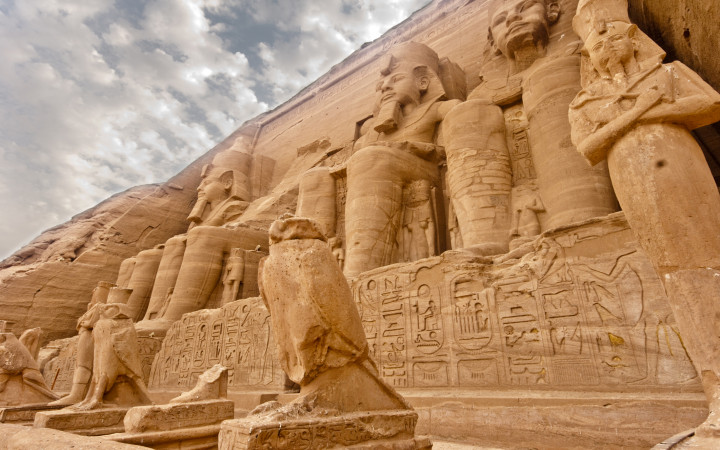
Would you like to travel back in time to ancient Egypt to find a mummy? That would be an incredible adventure, wouldn’t it? If you ever find a time machine and decide to make the journey, you might also want to brush up on the ancient Egyptian writing system that uses hieroglyphs.
Whether in movies or textbooks, you’ve probably seen examples of ancient Egyptian hieroglyphs. This system of writing, which is over 5,000 years old, used pictures instead of letters like our modern alphabet.
In ancient Egypt, the people who wrote with hieroglyphs were called scribes. Because hieroglyphs took so long to write (try writing your next homework assignment using pictures!), the scribes eventually developed an easier form of writing called Demotic script.
Over time, new scribes only used Demotic script. It was not long before no one could remember how to write or even read the old hieroglyphs!
When archeologists eventually discovered hieroglyphs on ancient Egyptian pyramids and tombs, they could not read the unique form of writing. They knew they had meaning, but no one knew how to interpret them!
This was a problem for many years. It wasn’t until just a little over 200 years ago a stone was found in Egypt that contained the key to unlocking the mystery of ancient Egyptian hieroglyphs.
The stone — called the Rosetta Stone after the name of the area in which it was found — was discovered by Napoleon’s troops in 1799 when they were invading Egypt. The stone had the same short story written on it in three types of writing: Greek, Demotic script and hieroglyphs.
Since scholars could read Greek and Demotic script, they were able to study the hieroglyphs to figure out how they worked. Jean-François Champollion was able to complete the translation by the 1820s. Today, the Rosetta Stone is displayed in the British Museum in London.
Scholars eventually learned that hieroglyphs were very complex. Although hieroglyphic writing consisted of pictures, the writing was more phonetic (based upon the sounds of a language, like our alphabet) than symbolic (pictures representing actual things or ideas).
Hieroglyphs are made up of three different kinds of glyphs (symbols). Phonetic glyphs act like alphabet letters. Logographic glyphs represent individual units of meaning, such as prefixes, suffixes or short words. Determinative glyphs help narrow down the specific meaning of phonetic and logographic glyphs.


(6 votes, avg. 3.50 out of 5)


Yay! First comment! Nice wonder of the day®! I didn’t know about these stuff until now… COOL!! Great job, wonderopolis!
(And by any chance can you make a wonder about ice cream? I’m a super fan when it comes to ice cream! Thanks!)
We’re sending you a big, virtual high five today, AnthenaMarie! We are so happy that you are WONDERing about the ancient writing system, hieroglyphs!! We think you have done a great job and we’ve learned something new together!!!
We’re big fans of ice cream here at Wonderopolis, too! Check out these past Wonders about your favorite frozen treat!
Wonder #354– What’s Your Favorite Ice Cream Flavor? http://wonderopolis.org/wonder/whats-your-favorite-ice-cream-flavor/
Wonder #664– Who Was the First Ice Cream Man? http://wonderopolis.org/wonder/who-was-the-first-ice-cream-man/
Hi Wonderoplis today’s wonder I really liked. I’m always wondering how they built the pyramids.
What a great suggestion for another fun-filled Wonder, Alex the minecrafter! Have you checked out this corresponding Wonder that goes along with our Egyptian theme?
Wonder #461– What Makes a Pyramid? http://wonderopolis.org/wonder/what-makes-a-pyramid/
I think that today’s wonder of the day is cool, but sort of strange. I thought it was cool how they use pictures for letters. But I don’t get exactly why they use pictures like birds for words. But overall it was AWESOME!!!
Hey there Siddman, thanks for joining us as we learn about hieroglyphs today! It’s WONDERful to look at earliest type of written communication, too! We think it’s interesting that children usually learn to draw pictures before they write words– just like the ancient civilizations did! Thanks for sharing your very AWESOME comment, Siddman!
I think today’s wonder was fascinating. I have been interested in hieroglyphs but never knew what they meant.
WOHOOO, we are so happy you liked our exploration into ancient history today, Pickle Boy!! Could you imagine unearthing these ancient forms of communication, just like the archeologists did? You really said it best– it’s FASCINATING! We are so glad to have great Wonder Friends like you to use our imaginations with!!
I never seen hieroglyphs before, or learned about, or knew them. I wonder how the people in the ancient Egypt or the experts know what the hieroglyphics mean. The hieroglyphics look like little kids drawing.
Great job WONDERing about the research behind hieroglyphs, Carlos! You could be an archeologist!! The original drawings are very simple but they were the ways in which people communicated. We Wonder what ancient civilizations would think of the way we communicate today– through technology!! Great comment today, Wonder Friend!
Since I didn’t know what hieroglyphs were, so I learned a lot today. The video was interesting and strange because they used pictures as words.
That’s so awesome to hear, Ayush, thanks for sharing your comment with us! We think it’s so much fun to learn something new, even when it happened many, many years ago! Have a WONDERful day!!
Thanks for the Wonder of the day® WONDERopolis!! It was SO cool, I’ve always WONDERED what hieroglyphs were… I didn’t even know what they called
. I think tomorrow’s wonder will be about hunters and what their prey do to get away from them!! OK I’ll see you tomorrow!!
Anna
YIPEE, we are so excited to see your comment about today’s Wonder, Anna!! Isn’t it so exciting to discover something new that occurred so very long ago?
Great guess for tomorrow– we cannot wait to have another WONDERful adventure again!
Hi Wonderopolis
There were some cool photos in the video but I didn’t see them all because the computers at school are a bit slow
From Maddi
Hey there, Maddi, thanks for sharing your comment with us today! We are SO EXCITED that you enjoyed the photos in the video– perhaps you can watch them another time when there are less students using the internet at school?
However, you should check out the link within the Wonder today– you can type in your name and find out what it looks like in hieroglyphs!
http://kids.discovery.com/games/just-for-fun/hierogenerator
How NEAT!
Hi! I’m in Mrs. Caplin’s class. I wonder how scholars only thought that hyroglyphics were complex! How anyone can understand them is beyond me!
Hope you’re having a WONDERful day, Mookie the cat! You have been doing a great job WONDERing about hieroglyphs and the scholars who study the ancient writings! We bet those scholars have done a LOT of research and have read many academic reviews in order to better understand the complex symbols! Maybe you can do some scholarly research of your own and develop your own version of hieroglyphs! It sounds like fun!!
It’s a really awesome video
From Kathryn
WOHOO, we are so excited to learn that you enjoyed today’s ANCIENT Wonder, Kathryn!! We are so glad you discovered an ancient type of communication with us!!
Hi wonderopolis
Are hieroglyphics ancient?
From Blade
Hi there Blade, what a great Wonder about hieroglyphs!! These forms of communication sure are ancient– we Wonder if you can find out how long ago they were discovered! Take a look at today’s Wonder to help guide you!
I think tomorrow’s is about heritage.
We are so happy you joined us today, Tiauna!! We think heritage is a very cool thing to Wonder about… nice job!
Have you checked out our past Wonder about heritage?
Wonder #347– Who Is Your Abuela? http://wonderopolis.org/wonder/who-is-your-abuela/
I was disappointed that there was no mention of the materials that were used to write on. This is one of the main reasons that archaeologists could not read hieroglyphs for hundreds of years, as scrolls were used instead of stones. Stones can last thousands of years, while scrolls crumble after only a few years.
I think tomorrow’s Wonder will be about the food chain.
Thank you for adding in that additional information to our hieroglyphs Wonder, Tori! We appreciate that you commented and helped our other Wonder Friends learn even MORE about those fascinating ancient hieroglyphics! We are SUPER happy to have a community of AWESOME Wonder Friends like you! Have a GREAT day!
Hi wonderopolis I found this wonder really interesting. I really liked this video. All your videos I’ve watched I’ve really liked.
Nice work, JulianaB123– we are excited to learn that you liked this Wonder, along with the video! Isn’t it fun to watch a video and read about it afterward? We think it’s a great way to use our imaginations and learn about new, fun facts!!
This was very cool and unique because you get to learn about ancient Egypt and the letters.
We Wonder if you have tried to figure out your name in hieroglyphs yet, Hockey2399?
We LOVE that you enjoyed our ancient Egyptian Wonder– and we are so happy you joined the learning adventure! You ROCK!
I am a bit confused but it is still soooooo cool and how do you do the smiley faces?
We think it’s great that you are WONDERing about the ancient form of writing, called hieroglyphs, Eric! It might be confusing to understand how people in the ancient civilizations used this writing technique, but it’s so COOL to see! We hope you keep up the great work– it’s okay if it’s not clear right away!
You can make a smiley face by putting a (semicolon) : and a (closed parenthesis) ) together. : + ) =
Excellent tool to use.
Thanks for WONDERing with us, Mrs. Xjimenez! We’re oh-so-glad you’re here! Hope to see you and your Wonder students soon!
Wow lots of info.
We hope you learned something new with us today, ES! Thanks for visiting us!
Dear Wonderoplis,
I’m reading a book about and writing one about Cleopatra. She lived in a town in Egypt called Alexandria. She had 3 sisters and 2 baby brothers. She has 2 friends named Olympus and Neva.
Ade from Lancaster
WOW, that sounds awesome, Ade! We are very proud of you for WONDERing about Cleopatra and her life! WAY TO GO! Thank you for telling us what you’ve learned about Cleopatra’s home and her family– we look forward to learning more about her, too!
Thank goodness we now have letters! ^_^ I’d hate doing assignments and projects using pictures instead of words! *sigh* Imagine writing an essay and taking 3 days just to do it.
But come to think of it…
Their “writing” seems fun.
We agree, Ran, letters today look much simpler than hieroglyphs, but we bet you would have gotten the hang of it if you lived in Ancient Egyptian times.
Thanks for sharing your thoughts about our historic Wonder! Hope to Wonder with you soon!