

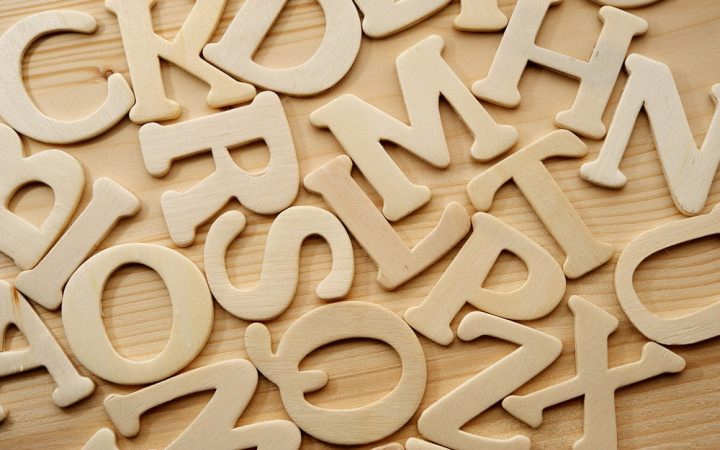
A, B, C, D, E, F, G, H, I, J, K, L, M, N, O, P, Q, R, S, T, U, V, W, X, Y, and Z! Now you’ve read your ABCs…and we bet you also sang them to the tune of the familiar song we all learn growing up. Didn’t you? Admit it!
Did you know that the letters of the alphabet can be divided into two different categories? It’s true! What are we talking about? Vowels and consonants, of course!
The 26 letters of the alphabet can be sorted into two groups: 21 consonants and 5 vowels. However, as you’ll learn in just a bit, at least one letter — y — can fall into either group depending upon its context.
The 5 vowels are A, E, I, O, and U. The 21 consonants are…well…all the other letters. How did the vowels come to be called vowels and all the other letters consonants? It’s all about how you say them.
Vowels are pronounced with an open mouth and no trapped sounds. Give it a try. Say A, E, I, O, and U. Did you notice how your lips don’t have to close to make these sounds? Airflow remains constant as you pronounce vowels.
The word “vowel” comes from the Latin word vocalis, which means “speaking.” The word “consonant,” on the other hand, comes from the Latin word symphonon, which means “pronounced with.” This is appropriate, since consonants are pronounced with trapped sounds.
In other words, you have to block the flow of air in some way with your mouth, lips or tongue when pronouncing consonants. Try it out. Say B, C, D, F, and G. Did you notice how each of these letters requires you to block the airflow in some way? For example, saying the letter B requires you to block airflow with your lips. The letter D requires you to block airflow with your tongue by pressing it to the roof of your mouth.
If you’ve learned about vowels and consonants in the past, you’ve probably heard that the vowels are A, E, I, O, U, and sometimes Y. That’s because Y can be a vowel or a consonant depending upon how it’s used.
The Y in “sky” would be a vowel, because it sounds like the vowel I. The Y in “yoga,” however, would be a consonant, because it is pronounced in a way that requires a blockage of air flow. Think of several other words containing the letter Y. Which ones use Y as a vowel and which ones use Y as a consonant?
One other helpful way to differentiate between vowels and consonants is to realize that vowels can be spoken alone, while consonants cannot. Say A, E, I, O, and U. When you say those vowels, you’re saying the vowel and that’s it.
Now say B, C, D, F, and G. If you think about it, you’re probably really saying “bee,” “see,” “dee,” “ef,” and gee.” So when you say the consonants, you can’t really say them without the help of the vowels!
Thanks to Tracey Guerin of Dublin, Ohio, for inspiring today’s Wonder!


(9 votes, avg. 4.11 out of 5)


The daily wonders are always fun and educational. Saying the letter “R” does not seem to follow the rule that you have to block the flow of air in some way with your mouth, lips or tongue to pronounce.
Thanks for sharing your comment, Tommy! We have been noticing how we pronounce the letter “R” now that you mentioned it! When we say a word that begins with “R”, like red or roller coaster, we realize our tongue goes down, behind our teeth. Try saying those words if your tongue was on the roof of your mouth! It’s tough! Thanks for helping us Wonder today!
Think of using the letter ‘r’ at the beginning of a word. Then you will notice that your lips come together – but not completely – to block the air.
I agree with you that when the ‘r’ is later in the word, as in the word ‘air’, you don’t block the air as much.
I love that you were testing the letters as you read this article!
I’m in Mrs. Hess’s class. YEAH! THIS VIDEO IS AMAZING HOW PEOPLE SING WITH THE MUSIC SO THAT THE ALPHABET MAKES OUT THE WAY IN ORDER! Who invited letters? Did God make up those letters?
I think tomorrow’s WONDER would be about who drinks in the saltly water, who is the 1st person tounching the land, who love to swim at the beach with a lot of sand, who invited boats and ships… and HAVE A GREAT SUNDAY TO ALL OF YOU!!!!!!!!!!!
P.S. Look my letters right to left to see my trick(s).
- .uoy ees I ,olleH
- !em ees uoy
I have some more, but I can’t tell my tricks! Thank you for supporting with us.
Hey there, Wonder Friend Kathy! We’re so glad you enjoyed our Wonder today! HOORAY! You’ve done a great job of WONDERing on your own, especially when it comes to guessing the next Wonder! Thanks for being a creative Wonder Friend, Kathy!
Dear wonderopolis
I think the video was really cool how did you do it?
Thanks so much, Pandalover! We’re glad you enjoyed today’s Wonder! We can’t take credit for the Wonder video, but we’re so glad you shared your comment with us! Keep up the great work!
Are the vowels and consonants diffrent sound groups?
I meant to say does every vowel have open syllables?
Hey there, Hannah, thanks for sharing your comment about letters, syllables and how they sound! Every vowel has an open sound to it– take a look at yourself in the mirror when you say “A” “E” “I” “O” and “U”– does your mouth look different or similar?
Wow I never thought of it that way before. You guys just made my day. I love wondering. I’ve always wondered how bacteria just multiplies by 2 in 30 minutes it’s crazy!!!
Also there is more bacteria in your stomach than people in the whole world
WOW, you’ve been doing a great job of WONDERing, Evan! Thanks for sharing your comment with us today! We’ve got a germy Wonder for you to enjoy while you think about bacteria:
Wonder #484- Can Germs be Good for You? http://wonderopolis.org/wonder/can-germs-be-good-for-you/
I thought today’s wonder would be like “what is football” or something like that. Because it is the Super Bowl today. GO 49ERS!
Hey there, Wonder Friend Sara! We’re glad you have been WONDERing about Super Bowl Sunday– we have too! Check out Wonder #126 for more information– http://wonderopolis.org/wonder/what%E2%80%99s-so-super-about-super-bowl-sunday/
Will forward this to my teacher friends. Thanks for sharing this video!
Thanks for sharing the Wonder, Marianna! We’re so glad you’re here! Have a SUPER day!
Thank you for picking Mrs. Guerin’s question. She taught us that in class and we wanted to share the information. We think it is interesting how letters sound based upon how the air moves through your mouth. Just like, m and n are nasal sounds because you can’t say their sounds when you hold your nose. Try it!
We think the English language is so interesting!
We REALLY liked the video because it taught us a bunch of new words!
We liked how the actions matched the words.
Thank you!
We’re so glad you’re here today, Wonder Friends in Mrs. Guerin’s 2nd Grade! We think you’re all lucky ducks for having a SUPER teacher like Mrs. Guerin!
Thanks to all our Wonder Friends in 2nd grade, we’ve learned more about the letters we use everyday to form words and sentences! Thanks for sharing your comment today!
I was wondering something while reading a great story by you! I wonder where you got your story information. – Rose U.
Hey Rose, thanks for using your imagination while you Wonder with us! Letters spark different ideas in all of us, including curiosity! We do a lot of research when it comes to WONDERing… including using our library, talking to experts and researching information on the Internet! Wonderopolis is like one big, cool research paper!