

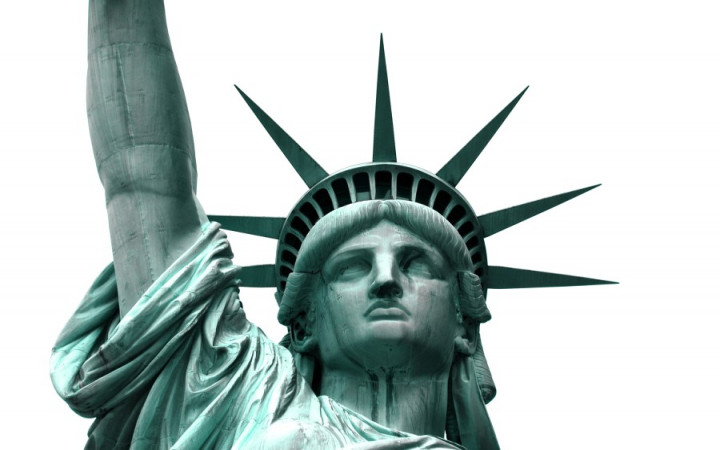
During the Revolutionary War, France became a close friend of Americans seeking freedom from Great Britain. To honor its friendship with America, France gave the U.S. a special gift: sculptor Frederic-Auguste Bartholdi’s beautiful statue called Liberty Enlightening the World.

The Statue of Liberty arrived in New York Harbor on June 19, 1885. It came in 350 pieces packed into 214 crates. The statue was assembled on a pedestal base built by the United States. The 151-foot tall statue has become a worldwide symbol of freedom and democracy.

The Statue of Liberty’s home is Bedloe’s Island (renamed Liberty Island in 1956). From 1892 to 1943, “Lady Liberty” greeted over 12 million immigrants as they arrived on boats at the nearby Ellis Island Immigration Station.

The pedestal of the statue features words from poet Emma Lazarus that reflect immigrants’ hopes and dreams for freedom in America:

Give me your tired, your poor,
Your huddled masses yearning to breathe free,
The wretched refuse of your teeming shore.
Send these, the homeless, tempest-tost to me.

The statue represents Libertas, the Roman goddess of freedom. She holds a torch in one hand and a tablet inscribed with the date of the Declaration of Independence in the other.

Built in France, the statue is made of hundreds of thin copper sheets assembled on a frame of steel supports. The inner framework was engineered and designed by Gustave Eiffel. He later used the same design on the Eiffel Tower in Paris.

Eiffel’s design allows the Statue of Liberty to move with changes in temperature and wind speed. It also allowed staircases to be built on the inside of the statue. Visitors can climb to an observation deck inside the crown.

The outer layer of the statue is copper that’s only 3/32 of an inch thick — the thickness of two pennies put together. Despite how thin it is, the copper is strong. The amount of copper in the Statue of Liberty could make 30 million pennies!

When the statue was originally assembled, it was a dull brown color, reflecting the natural color of its copper plates. Over the next 30 years, though, it slowly turned to the green color you see today.

What happened? Was it magic? Nope! It was science. A natural weathering process — called oxidation — took place when air and water reacted with the copper plates.

Over time, the weathering of the copper created a thin layer of copper carbonate called a patina. Although some people were worried that the changing color of the statue meant it was decaying, the patina actually protects the copper underneath from further corrosion.

Here are a few interesting facts about “Lady Liberty” you might not have known:

  • The statue alone stands 151 feet tall.
  • The pedestal stands 154 feet tall, making the top of the torch 305 feet above ground level.
  • The statue contains 62,000 pounds of copper and 250,000 pounds of steel. The concrete pedestal weighs 54 million pounds.
  • Winds of 50 miles per hour can cause the statue to sway up to 3 inches and the torch up to 6 inches.
  • The 7 points of the crown represent the seven seas and the seven continents.

25 Join the Discussion

1 Star2 Stars3 Stars4 Stars5 Stars  (7 votes, avg. 4.14 out of 5)
Loading ... Loading ...
    • Welcome, Debra! We’re so glad you commented today!

      You can check back every day for a new Wonder of the Day®! You can also search all 250+ of our past Wonders by clicking on the category links on the right side of each interior page of Wonderopolis.org or by using the search bar at the top of the page for a specific topic. We also encourage you to let us know what YOU are wondering about by submitting ideas for future Wonders of the Day. You can do that anytime by clicking on the “nominate a wonder” link at the top of each page!

      Thanks for stopping by today…have fun exploring Wonderopolis! :-)

  1. 1. I think it is green because the colour green is a famous colour.

    2. I think it is green because the people that made it wanted to make it green because they liked the colour green.

    By Atalia

    • Hi, Atalia! Did you know that Lady Liberty wasn’t always green? She is made of copper that used to be a dull brown color. Over time, a natural weathering process called “oxidation” occurred, turning the brown copper green.

      We think she’s a beautiful sight standing there in all her glorious green wonder! Thanks so much for commenting today! :-)

  2. i know why the statue of liberty is green is becuse at first she was copper but then the weathering came and it turned the brown copper into green copper

    • Sure, Lauren, ask away! We’ll do our best to answer your question…that’s what Wonder Friends are for! :-)

    • You can surely write your own full-length Wonder and make/submit a video if you want to (we think that would be AWESOME, by the way), but you can also just let us know the idea of what you’re wondering about in a few short words! We bet there are other Wonder Friends who are wondering about the same things you are, Lauren! Thank you so much for this comment! :-)

  3. Great site with tons of good material. Be sure, I’ll use it in my English classes. The information is interesting and clear.
    You’re choosing the questions in a “catching way”…Thanks for your marvelous job

    • Hi, Susan! Thanks so much for your great comment! We love to meet new Wonder Friends and look forward to hearing how you engage your students with Wonder! :-)

  4. Isn’t it true that she was in a big junkyard before being built? My teacher showed a video, “America the Story of Us”, last week.

    • Hi, Serena! There are so many interesting facts about the Statue of Liberty, aren’t there? We haven’t heard about the junkyard fact, but we will definitely check out the video your teacher showed you so we can learn some new things, too! :-)

    • Thanks for telling us you think Wonderopolis is the best, Alexia! We really appreciate your kind words and are SUPER proud of you for your great grade in English! Keep up the good work, Wonder Friend! :-)

    • Nice work, Wonder Friend Pancake! We think you’re on the right track– the oxygen atoms and the water reacted with the copper, creating a process called oxidation, which turned the statue the green color we now recognize! Thanks for WONDERing with us today! :)

    • That’s great, Nicole G! We are very proud of all the WONDERing you’ve been doing about the Statue of Liberty! Thanks for reading all about Lady Liberty– and we hope to see you soon! :)

Leave a Reply

Your email address will not be published. Required fields are marked *

You may use these HTML tags and attributes: <a href="" title=""> <abbr title=""> <acronym title=""> <b> <blockquote cite=""> <cite> <code> <del datetime=""> <em> <i> <q cite=""> <strike> <strong>

Share

  • Wonderopolis on Facebook
  • Wonderopolis on Pinterest
  • Print

Have you ever wondered…

  • Why is the Statue of Liberty green?
  • What is a patina?
  • Who designed the support structure for the Statue of Liberty?

Wonder Gallery

statue of liberty_shutterstock_24968719Vimeo Video

Try It Out

Ready to get up close and personal with Lady Liberty? Get some adventurous friends and family members to help you explore one or more of the following activities:

  • You don’t have to go to New York to get up close and personal with Lady Liberty. Just head on over to the National Park Service site to take a virtual tour of the Statue of Liberty!
  • The engineering that went into the Statue of Liberty is very impressive. To see some rare photos of the inside and outside of the Statue of Liberty, just jump online and head over to National Geographic’s Statue of Liberty Pictures page. Which pictures are your favorites? What impresses you the most? Why?
  • Up for a challenge? Grab some old pennies and a few common kitchen ingredients and have some Chemistry Fun with Pennies! With a bit of vinegar and salt, you can see with your own eyes why the Statue of Liberty turned green.


Still Wondering

Explore the nature of national symbols with EDSITEment’s The Statue of Liberty: The Meaning and Use of a National Symbol lesson.


Test Your Knowledge

Wonder What’s Next?

If you’re getting antsy for tomorrow’s Wonder of the Day, we understand. We can’t wait either!

Upload a Photo or Paste the URL of a YouTube or SchoolTube Video.