

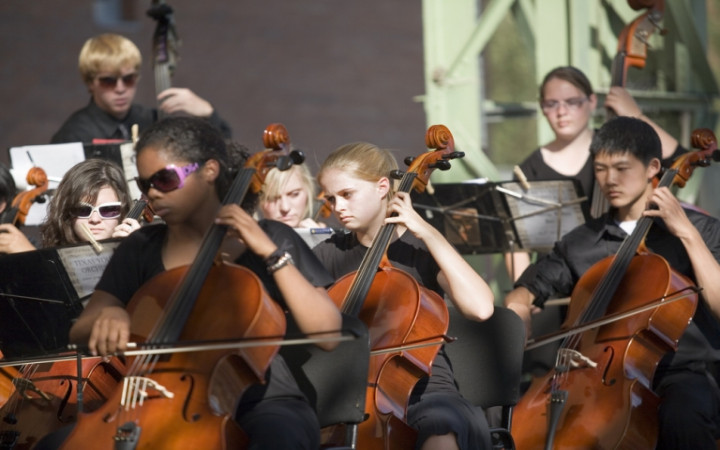
An orchestra is an ensemble, or group, of musicians who play a variety of instruments, including string, brass, woodwind and percussion. Generally, orchestras with fewer than 50 members are called “chamber orchestras," while full-size orchestras of 50 to 100 musicians are called “symphony orchestras" or “philharmonic orchestras."
The number of musicians required typically depends on the piece of music being performed and the size of the performance location.
Each group of instruments has a leader called the “principal." The principal is responsible for leading the group and playing solos. The principal trombone leads the brass section, while the principal oboe is the leader of the woodwind section.
The violin section is divided into two groups: first violin and second violin. The principal violinist of the first violins is called the “concertmaster." The concertmaster is the leader of the string section and helps the conductor lead the entire orchestra.
Before the orchestra begins, the concertmaster makes an entrance alone. He or she greets the public and then, along with the principal oboe, leads the orchestra as the musicians tune their instruments and prepare to play as a group.
The conductor is the leader of the orchestra. Each musician in the orchestra is familiar with his or her part of a piece, but a conductor must be familiar with the entire musical selection. He or she becomes a sort of musical traffic director, telling each instrument how fast they should play, when they should enter the musical highway and when to stop.
Of course, a conductor cannot use spoken words to communicate with the musicians over the music. Instead, the conductor communicates with the orchestra by waving a baton and using special hand and arm movements. The musicians understand these movements and adjust their playing based on the conductor's silent instructions.

