

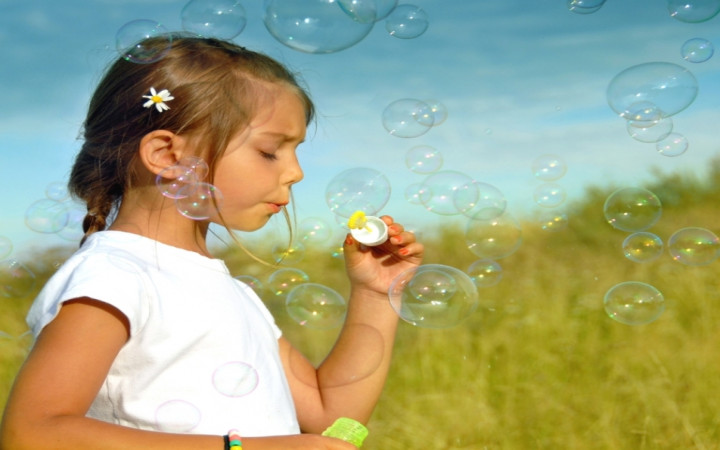
You may be surprised to learn that soap bubbles can’t really fly — they float! A bubble and the air trapped inside of it are both very light. In order to float, the bubble hitches a ride on a gas that is slightly denser than the air trapped inside of it: carbon dioxide!
All objects — solids, liquids and gases — are made of molecules. Density refers to how tightly packed the molecules of an object are. If the molecules of an object are very tightly packed, it has a high density. If molecules have more room to move around, the object has a lower density.
Because the air trapped inside a bubble is less dense than the air outside the bubble, it’s up, up and away! The heavier carbon dioxide in the air around the bubble pushes up on the air trapped inside the bubble and off it goes.
This upward force is called “buoyancy.” If you’ve ever watched a helium balloon or blimp go soaring off into the sky, you’ve already seen buoyancy in action!
Helium is a very light gas, which is why helium balloons float better than balloons filled with regular air.


But, why is the air trapped inside the bubble less dense? It was just as dense as all the other air mere moments before. The article does not explain what changes.
Hi, Star! We really appreciate your comment and that you are WONDERing even more about bubbles after exploring this Wonder about them!
Because the actual science of bubbles can get pretty complex (with factors like surface tension, surface area and volume ratios), we chose to give a basic (but still WONDERful) overview of why bubbles float for this Wonder of the Day®, so that even our youngest Wonder Friends might understand the reasoning behind the science. To help you (and any other Wonder Friends who might want to explore bubble science further), we have found some GREAT bubble links to explore:
http://www.exploratorium.edu/ronh/bubbles/bubbles.html
http://www.soapbubble.dk/en/
http://www.thinkingfountain.org//b/bubblegeometry/bubblegeometry.html
We hope you enjoy learning more about bubbles and the science behind them!
But a bubble still floats even if you don’t blow it, just waving the wand in the air creates a floating bubble, so basically it’s the surface area and difference in air pressure.
Thanks so much for sharing your thoughts about the science behind bubbles, Rollz! We appreciate your comment and are SUPER glad you stopped by Wonderopolis today!
Why is that whenever you look at a bubble real closely there’s kind of a swirl of colors?
What a SUPER Wonder, Dan! We bet you can do some WONDERing of your own about the way the light hits the bubble. We bet reflection has something to do with it, too…
We’re proud of all the great WONDERing you’ve been doing lately– keep up the great work!