

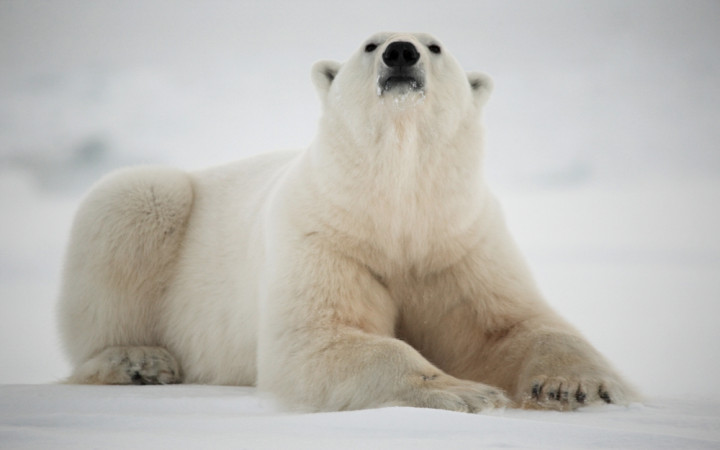
Ursus maritimus… that’s the Latin name of the majestic polar bear, the world’s largest terrestrial carnivore who inhabits the far northern regions of Greenland, Norway, Siberia and Canada.
Its name means “sea bear,” which is quite appropriate since polar bears spend most of their lives in, on or around water — mainly on the sea ice of the Arctic Circle.
Polar bears are among the largest land mammals on Earth. Male bears can weigh 700 to 1,400 pounds and stand 8 to 10 feet tall.
While polar bears are excellent swimmers, they prefer to stay on top of the ice that covers the Arctic Sea most of the year.
Why do they spend so much time on the frigid Arctic ice? The Arctic waters and ice floes are where their favorite food — seals — can be found.
Polar bears will also occasionally eat other animals, including walruses and dead whales, but seals are by far their favorite food. Seals can be tricky to catch, though, so polar bears must hunt with great stealth and patience. Fortunately, their white coloring helps them blend in with their icy surroundings.
So how did polar bears that live in a snowy-white world come to have white fur? Believe it or not, their hair isn’t actually white!
Their long outer hairs, which protect their soft, thick undercoat, are hollow and transparent. The thinner hairs of their undercoat are also colorless.
Polar bear hair looks white because the air spaces in the hairs scatter light of all colors. When something reflects all of the visible wavelengths of light, we see the color white.
Some scientists believe the polar bear was once a close relative to the brown bear. They think that, over time, polar bears moved to the Arctic, where they adapted to their surroundings by developing fur that would help them blend in with the harsh, white Arctic ice.
Not all polar bears look white, though. If you’ve ever seen a polar bear in a zoo, you may have noticed that its fur can appear almost green.
Scientists discovered that algae from the pond waters in the bears’ enclosures made the bears turn green. They learned these algae were found not on the surface of the hairs but inside the hollow hairs!


Hi, this is Haley from Mrs. Caplin’s class. This was a very interesting wonder. I learned a lot of new information including ursus maritimus is the latin name for majestic polar bear and means sea bear, male polar bears weigh 700-1,400 pounds and is 8 to 10 feet tall, and their favorite foods are walruses, dead whales, and their favorite by far is seals. The word adapt reminds me of Native Americans and how they adapt to their surroundings when they move by the seasons we learned in social studies at school. It surprises me that some polar bears hair at the zoo can appear almost green! I’ll have to look closer at the polar bears next time I go to the zoo. I am also wondering what is the weight and height of the average female polar bear? I learned a lot of new information. Thanks for the spectacular wonder!
We think it’s GREAT that you learned so many cool facts about polar bears, Haley! We’re also super proud of you for connecting a word (adapt) you read in this Wonder to what you already know about Native Americans! Thank you for leaving us such a WONDERful comment!
Polar bears are SO cute!
We agree, Samantha! Have you ever seen one before at a zoo? They are fun to watch as they splash around in the water and swim to the bottom of the pool! We think it would be fun to see polar bears in their natural environment, too!
Where do polar bears live?
Hi, teddybear! Polar bears live in the extreme northern parts of Greenland, Norway, Siberia and Canada.
I wish I could go to a zoo. I’ve never before.
We hope you get to visit a zoo sometime soon, Samantha! They are GREAT places to learn about animals. But, you don’t have to visit a zoo to see animals in action! Visit this page on the Smithsonian National Zoo’s website to visit LOTS of animals as they spend their days doing what animals do: http://nationalzoo.si.edu/Animals/WebCams/default.cfm. You’ll need to get a grown-up to help you sign up, but once you do, you can visit the animals anytime you like!
Polar Bears are awesome and I like watching them swim in the cold water.
We agree, Pizzacuttercat! Polar bears are AWESOME! Thank you for leaving us a comment today!
Polar bears are my favorite type of bear they’re so cute and fluffy but I would not want to get too close to them.
We think you’re on the right track, Emily! Polar bears are beautiful from far away, but we wouldn’t want to make them feel threatened by getting too close!
I like polar bears. I never knew that their fur could be colorless.
Way to go, Tyler J! We’re so happy that you learned something new!
I did not know that polar bears eat walruses and dead whales.
Cool article!
Great work, Kinsley, you’ve learned something new today! We think it’s great to Wonder about how animals survive, and where they are in the food chain. You can Wonder about that here: Wonder #701 WHO’S AT THE TOP OF THE FOOD CHAIN? http://wonderopolis.org/wonder/whos-at-the-top-of-the-food-chain/
By the way polar bears are my favorite animal. They are so cute!
Very cool! We LOVE WONDERing about bears of all kinds, but we think polar bears are the best at keeping warm in the cold! Thanks for WONDERing, Kinsley!
I’m writing a report about the polar bears and this is REALLY helpful. Thanks.
That’s super news, Rebecca! We’re thrilled that you’ve been WONDERing with us for your report! Keep up the great work!