

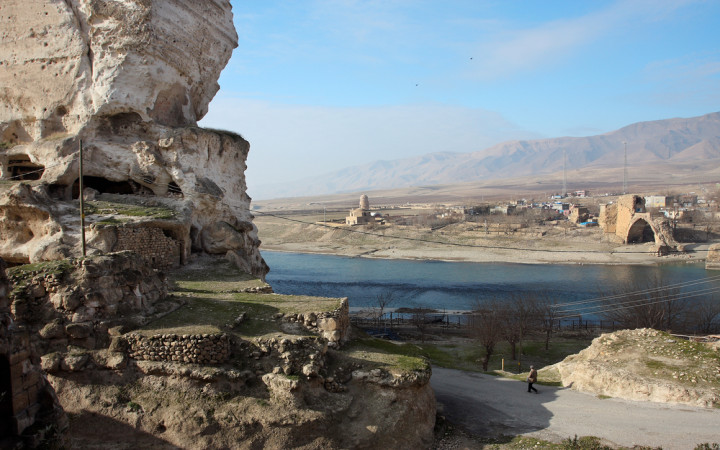
Have you ever WONDERed about ancient civilizations? What was life like thousands and thousands of years ago? Where did the first civilizations get started?
If you’ve ever studied ancient history, you’ve probably heard of a place called Mesopotamia and the Fertile Crescent. The Fertile Crescent — sometimes also called the Cradle of Civilization — is a crescent-shaped area in the Middle East that was known as the birthplace of several ancient kingdoms.
If you’re thinking that the Middle East is normally known for its deserts, you’re right! But the Fertile Crescent refers to areas of fertile soil near important rivers in the area. It stretches from the Nile River in Egypt to the Tigris and Euphrates Rivers in modern Iraq. It also encompasses several other countries, including Israel, Lebanon, Jordan and Syria.
The western edge of the Fertile Crescent borders the Mediterranean Sea, while the eastern edge reaches to the Persian Gulf. The Arabian Desert lies to the south of the Fertile Crescent.
Archeologist James Henry Breasted first used the term “Fertile Crescent” to describe the area. According to him, the Fertile Crescent was the first area settled in western Asia. Nomads seeking pastures for their flocks found the area good for farming and soon settled there. They found especially fertile soil in Mesopotamia, the area between the Tigris and Euphrates Rivers in what is now modern-day Iraq and portions of Iran, Kuwait and Turkey.
In addition to some of the earliest human civilizations, the Fertile Crescent also saw some of the first major technological inventions, including writing, glass and the wheel. The water sources and ability to grow crops in the area spurred many different civilizations over the years to thrive there.
In addition to the important rivers and marshlands in the Fertile Crescent, the area was also important because of its physical location as an area that bridged the three continents of Africa, Europe and Asia. As people from these areas began to explore other areas and develop trade routes, the Fertile Crescent flourished as a hub of travel and trade.
Changes over the past 30 years, though, have made the traditional Fertile Crescent much less fertile. Using satellite images of the region, scientists estimate that only 10% of the area’s important marshlands remain. The rest have dried up, leaving mainly desert with large patches of salt.
Experts believe much of the damage is the result of multiple countries building dams on the Tigris and Euphrates Rivers. They also point to extensive draining of the river basin over the past three decades. Many native plant and animal species have become endangered because of the loss of marshlands.


(8 votes, avg. 4.75 out of 5)


I liked reading about the Fertile Crescent. There is so much history there. I can imagine somewhere in that area is where God created the Garden of Eden. That would make sense.
I think tomorrow’s wonder will be about the rain forests or waterfalls.
Thanks for sharing your comment, Wonder Friend Tommy! We’re so glad you’ve been thinking about the Fertile Crescent, and all the different beginnings that took place there. We are glad you shared your Wonder guesses with us, too! See you tomorrow!
It looks like to me were it all started it was hot!
We agree, Crystal! The Fertile Crescent is situated in a very warm place, but the river helps to provide cool breezes and fertile soil! Thanks for sharing your awesome comment!
In my social studies class we learned about Fertile Crescent for 3 weeks.
WOW, what a great connection to our Wonder today, Marsha! We bet you and your classmates are becoming experts on the Fertile Crescent! HOORAY for WONDERing!
How horrible…. we know the cause, yet do nothing. Humans ate from the fruit of knowledge, most lack self control to use the it wisely.
Hey there, Wonder Friend Jennifer! We appreciate your comment about our Wonder, and we are glad you’ve been thinking about the impact humans have on the Earth overall. We hope to Wonder about all sorts of things, including keeping our world safe and healthy! We’re glad you visited Wonderopolis!
I learned this in my school. This wonder refreshed my memory. I think tomorrow’s wonder is about rain or moisture in farms.
We’re so glad to hear that today’s Wonder reminded you of what you learned in class, Dani! WOHOO! Thanks for telling us! We look forward to WONDERing with you again!
I was wondering that also where on earth is it? No idea!
Great question, Tessa! We learned that the Fertile Crescent is right near the Nile River in Egypt! Thanks for asking– we love WONDERing with you!
Wow that is super cool
I liked this a lot at first I thought it was Egypt! Thanks for the wonder!
Nice work, Blakeleigh- you’re right about the location! Egypt is correct! We’re happy you found this Wonder to be super cool– just like you!
Hi, me and Marsha are in the same school so I also learned about the Fertile Crescent already. It is a very cool subject!
How cool, Wonder Friend Josephine! We think it’s great that you, Marsha and your Wonder classmates have been WONDERing about the Fertile Crescent! SWEET! We are so happy to hear that you enjoyed our Wonder– thanks for sharing your comment!
In my school TYWLS we learned about the early civilizations and and about Mesopotamia. In Mesopotamia the ancient Egyptians get their food from cultivating and from the soil being very fertlized for them plant food to reach basic need.
WOW, thanks for sharing what you learned about Mesopotamia, Monique! We are so glad this Wonder connected to your lessons at school– that’s AWESOME! We have had a great time WONDERing about different types of civilizations with you– we hope to see you soon!
Hi it looks so hot where it all started.
We agree, Wonder Friend! It looks like you and Wonder Friend Crystal are on the same page today! Thanks for sharing your comment!
WOW I never knew that and I love reading about the Fertile Crescent!!!!
WOHOO, we’re so glad to hear it, Wonder Friend Ania! Thanks for sharing your comment today!
Hey I loved today’s wonder it really made me wonder. And I think that tomorrow’s wonder will be about rain?
Your wonder friend Chloe.
We’re so glad to hear it, Wonder Friend Chloe! We think it’s great that you learned something new with us! We think you’re on the right track for the next Wonder of the Day®, too!
I am in the same class as Marsha is in and we did learn about the Fertile Cresent in Mesopotamia,
so that is a great conection to the wonder of today!
WOW, how cool, Yennifer! We think it’s so great that so many Wonder Friends are making awesome connections… from the classroom to Wonderopolis! HOORAY for WONDERing! Thanks for visiting us!
People trade for better stuff.
You’re right, Nikolas! That was how people in ancient civilizations bought new things– they would barter! Great job!
I learned about the Fertile Crescent for 3-4 weeks it was quite interesting.
WOW, we bet you learned a LOT about the Fertile Crescent during that time, Kori! Thanks for sharing your cool comment, Wonder Friend!
Yay! We’re learning about ancient civilizations.
That’s really cool.
I think the next wonder is ‘Why does it rain’
or How?
Perfect timing, Sara! How cool that this Wonder and what you’re learning in school are related! YIPPEE! We think you’re on to something for the next Wonder, Sara! Bring your umbrella!
In my social studies class we are learning about this. We have been studying it for 3 weeks!
WOW, we’re glad to hear it, Jesenya! It sounds like you’re becoming an expert on the Fertile Crescent!
Thanks for sharing your comment with us; we are glad to hear that we’re WONDERing about the same topic you’re studying in school!
The fertile cresent is located in the Middle East. The Middle East is also called the birthplace.
Hey Robert! Those are two great facts from our Wonder! That is why the call it the Cradle of Civilization. Thanks for WONDERing!