

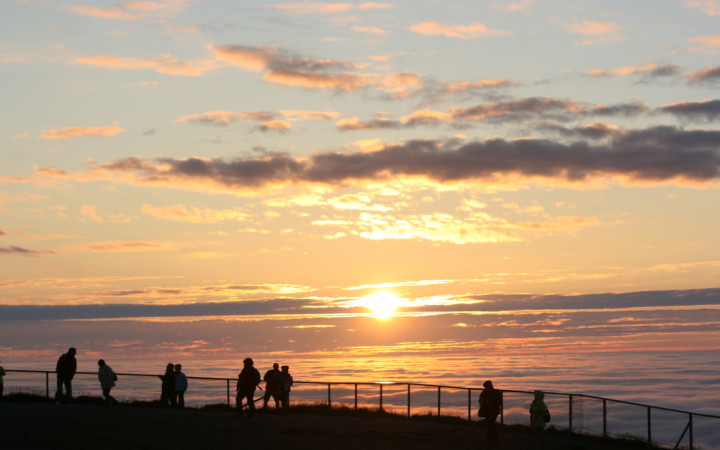
Which do you prefer? Long summer days when the sun doesn’t set until late in the day? Or short winter days when it gets dark shortly after school is out? If you’re like most kids, you probably prefer those long summer days.
If you want to maximize your sunlight during the summer, you might want to head north. WAY up north! How far north? Try the Arctic Circle!
During the summer, the sun does not set above the Arctic Circle. In fact, this phenomenon is what helps to define the Arctic Circle. Like the equator, the Arctic Circle is an imaginary line. It’s defined as the latitude above which the sun does not set on the day of the summer solstice (usually around June 21).
North of the Arctic Circle, periods of constant sunshine last for up to six months of the year at the North Pole. The opposite is also true for parts of the year, though. Above the Arctic Circle, the sun never rises on the day of the winter solstice (usually around December 21). Do you think you could live somewhere where it’s always day for half of the year and always night for the other half of the year?
There are several countries with areas within or that border the Arctic Circle. Many people call such areas “the land of the midnight sun,” because in summer the sun can often be seen past midnight. Some of these areas include the northernmost parts of Canada, Greenland, Finland, Norway, Sweden, Russia, Alaska and Iceland.
If you really love the sun, you might think about a spring and summer vacation to Svalbard, Norway. The sun doesn’t set there from about April 19 to August 23 each year!
This phenomenon occurs because the Earth is tilted on its axis by approximately 23 degrees. At the poles (both north and south), this means that the sun only rises and sets once each year.
Of course, these phenomena aren’t limited to only northern areas. They also occur in southern regions near the Antarctic Circle. However, there are no permanent human settlements near the Antarctic Circle, so very few people experience these phenomena there.
The people who live in these areas eventually get used to the constant sunlight/darkness for extended periods of time. Newcomers or visitors, though, often find it hard to adjust and may have trouble sleeping, especially when the sun is shining all night long.


(11 votes, avg. 4.36 out of 5)


Wow I never knew all this could happen you guys are really good. But I have a WONDER, why does it change directions just becuase we are on different areas of the Earth.
How cool, Wonder Girl Rocks! We’re thrilled that you learned something new today! Also, thank you for sharing your very own Wonder with us… we bet you’ll enjoy this Wonder from the past– it has to do with directions!
Wonder #7– How Can You Be A Human Compass? http://wonderopolis.org/wonder/x-marks-the-spot/
Today’s wonder got me thinking. At school, Andrea is learning about the sun, earth and the moon, and she learned that in the north and south poles, you could either get 24 hours of darkness, or 24 hours of light.
Very cool, we’re excited that our Wonder Friends Andrea and Natalie are WONDERing about that bright sun today! The solar system is a very cool thing to Wonder about!
Hey Wonderopolis!!! Wondergirl101 here to finally comment. I knew half of that well about 60%. I could never ever sleep with the sun shining!!!! Or do days things in the darkness!!!!!
I think tomorrow’s wonder of the day will be about why is it good to challenge yourself.
Phew, we’re glad you’re back, Wondergirl101! We think it would be difficult to adjust our schedule, too! We’re quite used to do things according to the sky– it’s it is light or dark outside! However, we think it’s cool to imagine our lives flip-flopped around. It would be an opposite kind of day!
It is totes awesome! Keep up the fab wonders!
Thanks so very much, Zendaya C! We think you’re totally fabulous, too!
That is really cool. I want to visit the Arctic Circle one day.
We bet it would be an AMAZING adventure, Gabrianna! Thanks for sharing your dream with us!
I loved today’s WONDER reading, but can you please explain to me what the video was showing?
We’re glad to hear it, Josephine L! The video shows a time lapse (like fast-forwarding a video) of nearly 20 days in Norway. This way, we can see how long the area stays light, and dark!
I like the sun. I think tomorrow’s wonder of the day is going to be about taking tests, how to take out libary books, or how to put yourself to the test!
Oooh, such great guesses, Grace! We’re glad you’re back and WONDERing with us… we sure hope to see you soon!
I think tomorrow’s wonder is going to be about a library book. I thought today’s wonder was pretty cool. I didn’t know that the sun only rises or sets once a year at the poles. I would have a hard time sleeping!
What a great guess, Eoin! We Wonder if you go to the library often? We have a Wonder you might enjoy… Wonder #568– Where Is The Largest Library in the World? http://wonderopolis.org/wonder/where-is-the-largest-library-in-the-world/
We think it would take some getting used to as well, Eoin! Sleeping while it’s light outside might be difficult at first!
I had no idea that the sun did not set in places!
Sincerely Danielle
It’s so much fun to learn something new everyday, Danielle! HOORAY for WONDERing!
WOW! I wonder what it would be like to grow up there?
We bet it would be very cool, Joy! It might take some adjusting… we’re not used to sleeping while it’s light outside!
The sun has not shined in days here in Northern Louisiana! The clouds are too thick. My Grandpa said we will get sun sooner or later!!!
Yikes, we hope you get some sunshine soon, Brenard!
That is pretty awesome. The sun never setting. ahhh. I can see it now, but I don’t think anyone wants to live up there but it would be nice. ND or the Arctic Circle?
Hey there, Wonder Friend D! We’re glad you enjoyed WONDERing about places where the sun never sets– we think it would be cool, too! It might take us some time to adjust to sleeping while the sun is still out!
Hellooooo well it’s amazing I didn’t know I thought the sun set everywhere wow.
Hi there, Wonder Friend arleth! We are so glad you learned something new with us today!
We are now doing our project on this topic!
HOORAY, Jasmine and Sarah! We’re so excited to hear that great news! Have a WONDERful time!
I would like to know how it works. Specifically, why is there a time lapse in certain areas? It seems as if the sun goes around the globe, so why does it not go away in some areas? Does it affect how the temperature and science of that place work or are documented? I want to know all about it. Please reply back!
-Julia
Hi there, Wonder Friend Julia! We’re so glad you’re WONDERing about the sun with us today! The sun stays out in certain areas due to those locations– the North and South poles. The Earth’s axis also has a lot to do with it:
“This phenomenon occurs because the Earth is tilted on its axis by approximately 23 degrees. At the poles (both north and south), this means that the sun only rises and sets once each year.”
We bet you can do some more WONDERing with the help of your teacher, librarian or family! We are very proud of you!
A sun that never sets. That is awesome.
We think it might take some time to get used to sleeping while it’s bright outside, but we think it’s pretty cool, too, Tyler!