

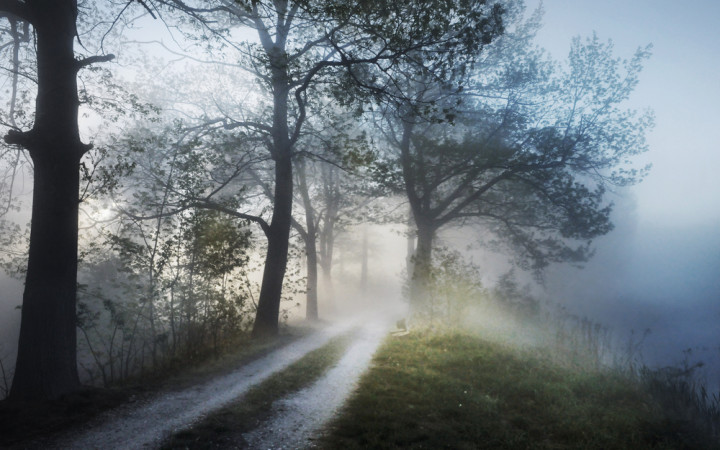
Where does fog come from? Would you believe us if we told you we don’t have the foggiest idea? Probably not… we’re in Wonderopolis, after all!
The next time you wake up in the morning to dense fog, you can say “It’s cloudy outside!” instead of “It’s foggy outside!” Why? Because fog is just a regular cloud that happens to be close to the ground rather than high up in the air.
So how does fog get down here close to Earth? Does a strong wind blow a cloud out of the sky down to the surface of the Earth? Not quite…
Fog actually forms close to the Earth where we see it. The same scientific processes that usually happen way up high in the atmosphere to create clouds can take place closer to the ground. When they do, we get fog.
Basically, fog forms when warm air meets colder air. When this happens, water vapor in the air — a gas — is cooled enough for the gas to turn to a liquid in the form of tiny water droplets. This process is called “condensation.”
We see those groups of tiny droplets as clouds or, when they’re close to the ground, as fog. As the air heats up again, fog will slowly disappear as the tiny water droplets once again return to a gas in the form of water vapor.
There are four main types of fog. Radiation fog occurs when the ground radiates heat outward while the air above the ground begins to cool after the sun sets. If the temperature of the air sinks below its dew point, water vapor will condense around dust in the air to form fog.
Advection fog occurs when warm air moves in over a cooler land surface. This happens often along coastlines, for example, when warm ocean breezes blow in over cooler land. The land cools the warm air below the dew point, and fog forms.
Upslope fog occurs when warm air passes over the upward slope of a cool mountain. As elevation increases, the mountain cools the air quickly, causing condensation and fog.
Evaporation fog occurs when extra water vapor comes into contact with air that is already heavily saturated. Because the air can only hold so much water vapor, adding extra water vapor from evaporation, such as from a lake in the hot sun, can cause the air to reach the dew point and form fog.
While it can be neat — and sometimes a bit creepy — to see fog, it can also be dangerous. When fog is very thick and near the ground, it can reduce visibility to only a few feet. This makes driving in fog particularly dangerous.
The foggiest place in the world is the Grand Banks off the coast of Newfoundland in Canada. Here, the cold Labrador Current from the north meets the warm Gulf Stream from the south, creating the perfect conditions for fog.
Other very foggy areas include Argentina, Labrador and Point Reyes, California. Each of these areas reports more than 200 foggy days every year.


(11 votes, avg. 3.64 out of 5)


Friends of mine visiting me in San Francisco asked for an explanation of fog just a few weeks ago! This Wonder does a much better job of explaining it than I did…and I know they’ll love the experiment. Great post!
Thanks for letting us know you liked this FOGGY Wonder, Christine! We think it would be neat to live in San Francisco and be able to walk around in the “clouds” so often!
Hi! It is Jillian from Mrs. Caplin’s class! I think this wonder is very interesting, I learned a lot! My favorite fact about fog is that fog actually forms down low. I also learned that the foggiest place in the world is the Grand Banks.
Hi, Jillian! We’re so glad that you learned new things from this Wonder of the Day® and also that you visited Wonderopolis! We think Mrs. Caplin is a GREAT teacher who inspires her students to WONDER about the world around them! We hope you have a GREAT school year!
Hello! We came upon this website when we did a Google search about fog. We are learning about weather in science, and we have studied the water cycle and how clouds are formed by condensation. This morning, it was foggy in our town. Now we can say that it was cloudy!
Thank you for teaching us about how fog is formed!
Welcome to Wonderopolis, Mrs. Guin’s Second Grade! We’re so glad to hear you learned some cool new facts about fog by exploring this Wonder of the Day® together! We hope you will visit Wonderopolis again soon…we have a new, exciting Wonder every day!
Hello wonderopolis! This was a great wonder. I learned a lot of cool new facts. Here are two new facts I learned. I learned that fog is a regular cloud close to the ground rather than high up in the air. I also learned that basically fog forms when warm air meets cold air. When this happens water vapor in the air- a gas- is cooled enough for gas to turn to a liquid in the form of tiny water droplets. This process is called condensation. One question I have is why are clouds and fog white? Two vocabulary word I learned are advection and upslope.
Thank you wonderopolis!
We like your question about the color of clouds and fog, Team McNeil 20! Have you visited past Wonder #306 – Why Is the Sky Blue? We think you will REALLY like it, and it might help answer your question a little better! Here is a link that will take you right to it: http://wonderopolis.org/wonder/why-is-the-sky-blue/.
Thank you for making this article! I think it was very interesting.. I live in Massachusetts and there’s mist and sometimes fog here in the morning. I have a friend in Ohio that said that he had never seen such a thick fog before and that in Ohio it pours down from the hills. I assumed it was caused by trees, or wetlands…
We’re so super happy that you liked exploring this Wonder of the Day® and learning more about fog, Alex! Thanks for sharing about the differences in where you and your friend live. It’s fun to learn about the weather in different parts of the country (and the world), isn’t it?
I really like this video.
We’re so happy to hear that, Baheer! It was FUN to learn where fog comes from, wasn’t it? Thanks for being a GREAT Wonder Friend!