

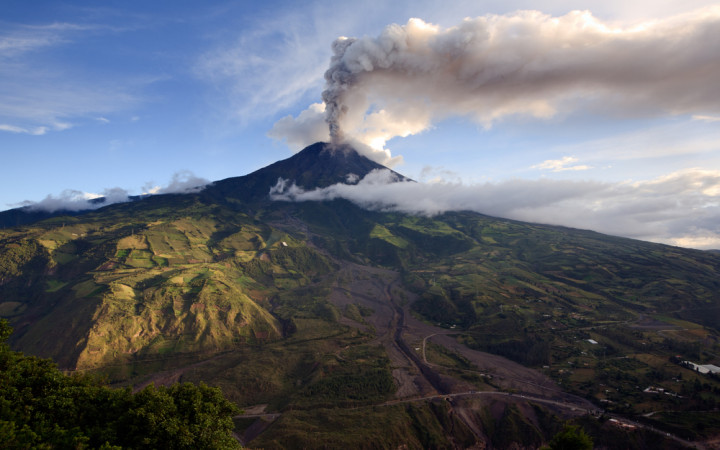
Today’s Wonder of the Day was inspired by braden from AL. braden Wonders, “How are volcanoes formed!?!?” Thanks for WONDERing with us, braden!
The Earth consists of three layers. The outer layer of Earth we live on is called the crust. It's about 18 miles thick.
Below the crust lies an 1,800-mile thick layer called the mantle. A combination of molten rock and gases called magma lies between the Earth's crust and the mantle. The innermost layer is called the core.
A volcano is a mountain that extends down to a pool of magma between the crust and mantle. It's basically a hole in the Earth from which magma can erupt. The name "volcano" comes from the name of Vulcan, a god of fire in Roman mythology.
Volcanoes are like huge safety valves that release the pressure that builds up inside the Earth. When pressure builds up, eruptions occur. Magma shoots up through the volcano and flows down its sides. When magma flows out of a volcano, we call it lava. Fresh lava can be as hot as 2,200° F, glowing red or white as it flows.
Eruptions can cause mudslides, avalanches, and floods. Volcano eruptions have knocked down entire forests and triggered tsunamis and earthquakes.
As they erupt, volcanoes spew huge clouds of volcanic ash into the atmosphere. The ash consists of tiny bits of rock and glass. Ash clouds can cover hundreds of miles, creating problems for airplanes and changing weather patterns. Volcanic ash can also damage the lungs and cause other respiratory problems for those who breathe it.
The United States contains several active volcanoes, mainly in Hawaii, Alaska, California, Oregon, and Washington. Hawaii and Alaska have the greatest chance of experiencing eruptions near areas where many people live.
Here are some interesting facts you may not know about volcanoes:
- Historical records exist for almost 600 volcanoes around the world, while some scientists believe there are over 1,500 active volcanoes! No one really knows for sure how many volcanoes exist under the oceans.
- Over half of the world's volcanoes arise in a belt around the Pacific Ocean called the Ring of Fire.
- On any particular day, approximately 20 volcanoes are in the process of erupting.
- The “danger zone" of a volcano extends for up to 20 miles in all directions.
- On May 18, 1980, Mount St. Helens erupted in Washington, killing 58 people and causing over $1 billion in property damage.

