

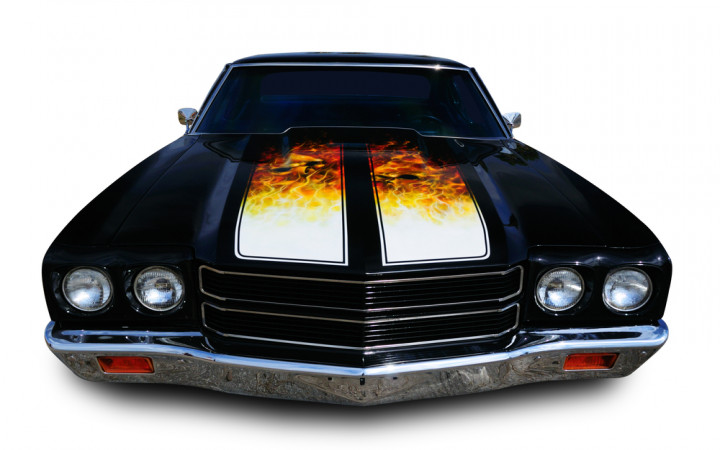
You've probably seen lots of movies with high-speed car chases. You may even dream of one day driving one of those sleek, high-performance automobiles that can go from 0 to 60 miles per hour in a matter of seconds. If so, you've got your sights set on a muscle car.
"Muscle car" is actually a term used to describe a wide variety of powerful, high-performance vehicles. While some people have definite opinions about what qualifies as a muscle car and what doesn't, the term usually applies to two-door, rear-wheel-drive, small to midsize cars with large, powerful eight-valve (V8) engines.
Muscle cars became popular with young drivers in the mid-1960s. Not only were they sleek, attractive, and powerful, they were also affordable and able to be driven for everyday street use, as well as formal and informal drag racing.
Compared to modern cars, which tend to have smaller four-valve (V4) or six-valve (V6) engines that use less fuel and are better for the environment, muscle cars tend to be smaller cars with big, oversized engines.
The earliest muscle cars were not particularly fuel-efficient or environmentally friendly. Of course, fuel was cheaper in the 1960s, and science had not yet revealed many of the environmental impacts of vehicles at that time.
Many muscle car enthusiasts believe the 1949 Oldsmobile Rocket 88 was the first true muscle car. It boasted America's first overhead valve V8 in a relatively light body, giving it a lot of power and speed.
Manufacturers began to compete, offering more powerful engines year after year. Eventually, they produced muscle cars with engines rated as high as 450 horsepower.
Although the science behind the measurement of horsepower is quite complex, you can imagine how powerful an engine would have to be to equal the power of 450 horses!
These speedy muscle cars could travel in excess of 120 miles per hour, which made them popular as informal drag racers. Some cars could go from 0 to 60 miles per hour in less than 10 seconds.
Auto manufacturers began to tame their muscle cars in the 1970s. In response to complaints by Ralph Nader and others who wanted auto manufacturers to focus more on safety, the automotive insurance industry began to charge more for insurance on muscle cars. At the same time, gas prices began to rise, and efforts were under way to fight air pollution.
All of these factors led to the decline of the muscle car in the 1970s. Auto manufacturers concentrated their efforts on lowering horsepower, increasing luxury, improving fuel economy, and reducing emissions.
Today, auto manufacturers still make powerful models that appeal to racing enthusiasts. For the most part, though, these models aren't as affordable as the muscle cars of old.
Classic muscle cars, such as the Dodge Charger R/T, Ford Mustang, Plymouth GTX, and Pontiac GTO, have become collector's items for muscle car enthusiasts. Some of these old models are relatively rare today and have been valued at up to $500,000. Extremely rare models, like the 1969 Chevrolet Camaro ZL1, are seen as museum-worthy artifacts!

