

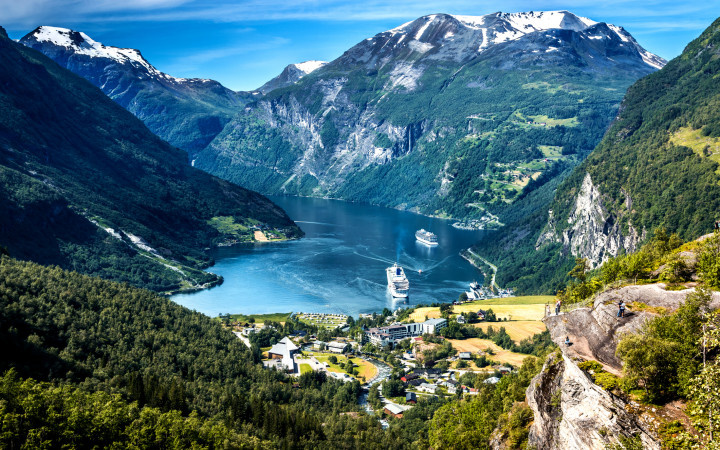
“Fjord” is a funny word, isn’t it? You pronounce the “j” like a “y,” so you say “fyord.” It’s even fun to say in a tongue twister: Fifty-five fishermen fished for fish for forty-four days in the fjord!
But what exactly is a fjord? It sort of sounds like a European version of a Ford automobile, doesn’t it? Well, it’s not an automobile, but you can find fjords in Europe.
A fjord is a long, narrow waterway that’s surrounded by steep cliffs on each side. Fjords were carved out of valleys long, long ago by glaciers.
When glaciers covered the Earth, they would often cut long, U-shaped valleys out of the bedrock in certain areas. As the glacier moved through these areas, glacial melting would eventually occur, leaving a long, narrow waterway in its path.
Because of the steep cutting action of the glaciers, most fjords are deeper than nearby seas. For example, Sognefjord — a fjord in Norway — plunges over 4,000 feet below sea level.
As glaciers formed fjords, they would often leave deposits behind that would create a rise at the mouth of the fjord. This rise can cause some fjords to have very strong currents or even saltwater rapids.
Another dangerous feature found near some fjords is the presence of thousands of small, rocky island blocks. These areas are called skerries and they can be treacherous for ships to navigate.
Because they were formed by glaciers, fjords tend to be located in mountainous areas close to large bodies of water. For example, Norway is famous for its fjords. You can also find fjords along the west coast of Europe, Alaska, Canada, Greenland, New Zealand and Chile.
Recently, scientists have discovered coral reefs at the bottom of many fjords in Norway. They’re not sure what processes led to the formation of these coral reefs. However, they do think that the marine life that exists in these coral reefs might explain why the Norwegian coastline is such a good place to fish.
Two of the most extreme fjords in the world can be found in Greenland and Antarctica. Scoresby Sund in Greenland is the longest fjord in the world, measuring 217 miles long! Skelton Inlet in Antarctica is the deepest fjord in the world at 6,342 feet deep!


(3 votes, avg. 4.33 out of 5)


Hi Wonderopolis,
I love this wonder! It was really interesting to learn about ‘Fjord’. I’m so happy I get to learn a new thing everyday, thanks to you.
What a REALLY AWESOME comment you left for us today, Aparajita! We thought it was fun to learn about fjords, too! It was interesting to learn how deep some of them are, and also how dangerous some of them can be to navigate! We’re SUPER happy that you are happy to learn new things in Wonderopolis! YOU ROCK!
I got the first comment!
You were super close, asddhs! Aparajita was the very first Wonder Friend to leave us a comment today, but leaving the second comment is just as AWESOME! Thank you for visiting today’s Wonder and letting us know you were here! We appreciate your comment very much!
I read a book called Snow Treasure. It was set in Norway. There was a fjord in it. I recommend you to read it. WONDEROPOLIS made me want to go to Norway.
I think tomorrow’s WONDER is about how military people communicate with each other.
Hi there, Charlie! We will have to check out that book…THANKS for suggesting it! We think it would be SUPER fun to visit Norway, too! There are LOTS of places to WONDER about fjords around the world!
Dear Wonderopolis,
YES!!! TJ and I were right!!! Cool wonder btw!!! I think tomorrow’s wonder is about balloons or about helium.
XOXOXOXOXO,
Paige
Great job, Paige! You are a very good Wonder guesser! Thank you for visiting today’s Wonder and also for sharing your comment with us!
THIS WONDER WAS AMAZING! I had never heard of Fjord before it was GREAT to learn about it!
We’re so glad to hear that you learned something new by exploring today’s Wonder, Besty! We did, too! We never knew how deep some fjords can get, or all the WONDERful places we can find fjords in the world!
That video was beatiful with the fjord!
Thanks for letting us know you liked the video for today’s Wonder, Alexa! We thought it was beautiful, too! It makes us want to see a fjord in real life!
Hi
so how was your weekend?
By see you on Monday
Hello, Chase! Our weekend was just WONDERful, thanks so much for asking! We hope you had a SUPER GREAT weekend, too! Thanks for being such an AWESOME Wonder Friend!
Hello,
I am soooo excited to discover this WONDERFUL site. I am an educator, can’t wait to share it with my students when school begins. Thank you for wonderizing us!!!
Welcome to Wonderopolis, Cathy! We are so glad to count you as a new Wonder Friend! We can’t wait to hear what amazing things your students WONDER about! Be sure to check out the blogs of our Wonder Lead Ambassadors (all educators) to learn some really cool ways to engage students of all ages with WONDER! Here’s a link so you can get to know them a bit better: http://wonderopolis.org/wonderyear/.
Happy WONDERing!
I like this wonder. (:-)
We’re glad you enjoyed learning about fjords with us in Wonderopolis today, Julie! Thanks for stopping by and sharing your comment! We think you are an AMAZING Wonder Friend!
Fjords do not have to have cliffs. There are fjords in Denmark, but there are no cliffs by them as the land is relatively flat. Check out the Limfjord and the Mariagerfjord. I’ve seen these personally, and there are no cliffs.
Thanks so much for adding something extra awesome to this Wonder of the Day® with the information about those two fjords in your comment, Kathy! We appreciate when our Wonder Friends share their personal knowledge with us! Have a WONDERful day!