

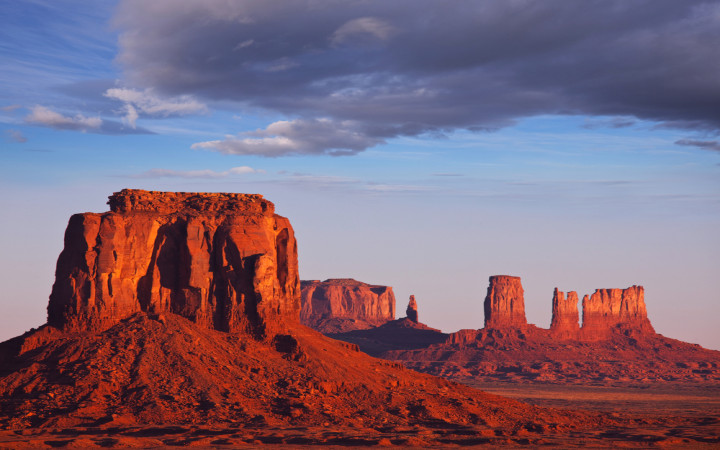
Would you like to have been one of the first explorers to venture into the Old West? Today, places like Colorado, Montana, Wyoming, Utah and California call adventurers and nature lovers to their beautiful sights. Can you imagine what it would have been like to travel miles and miles to be greeted finally by the majestic Rocky Mountains?
We WONDER what explorers thought when they first saw the tall, isolated rock formations of Monument Valley in Utah. What are we talking about? Buttes, of course!
A butte is a prominent isolated hill with steep sides and a small, flat top. In fact, the word “butte” comes from a French word meaning “small hill.”
A related geological feature is the mesa, which is distinguished from the butte by its much larger size. Buttes, for example, usually have a surface area of less than 10,000 square feet. Mesas, on the other hand, can have as much as four square miles of surface area.
In addition to size, geographers often use another simpler way to differentiate buttes from mesas. Mesas have tops that are wider than they are tall, while buttes are taller than they are wide.
Both buttes and mesas are formed by the scientific process of physical weathering of rock formations. Weathering refers to the process by which rocks are broken down into smaller pieces without substantial movement.
Buttes and mesas, for example, are formed when the surface material of a hill or a mountain — called the cap rock — resists physical weathering but underlying materials (usually softer rock) do not. Over time, the underlying materials break down through a process called erosion, leaving an isolated, flat-topped hill called a butte (or a mesa if it’s really large).
Buttes and mesas are usually found in fairly dry areas. When plants and ground cover are scarce, the softer rock layers of buttes and mesas are left exposed to running water. Over time, softer rock erodes, leaving steep, vertical sides and gently-sloping bases where the eroded rock collects.


(11 votes, avg. 3.55 out of 5)


Hello fellows! I’m in Mrs. Hess’ class and I think this video is BEAUTIFUL and WONDERFUL! Who invited those rocks? Do people live there? How many rocks are there in the video? I love to see rainbows in the amazing video!
I think tomorrow’s WONDER OF THE DAY is about tigers, lions, cows, insects, pets… and have a great daytime!
P.S. I LOVE YOUR WONDERFUL WEBSITE!!!!!!!
Hi there, Kathy! Thanks again for sharing your comment with us today! HOORAY for WONDERing!
We LOVE when rainbows are part of our day, too! Thanks for making us smile with your WONDERful guesses for tomorrow! We will see you then!
I really enjoyed the this wonder, I liked the picture with the rainbow in the background. Also, I was correct from yesterday I said,” I think tomorrow will be about pretty places to visit.” I think tomorrow will be about the Everglades National Park because lots of animals roam around there.
Nice work, Briahna, you were oh-so-right!
We’re glad you are back, WONDERing with us today! Thanks for sharing your super guess, Briahna!
Wow! I am first to comment! Today’s wonder was really cool! It was fascinating to learn that buttes are formed when rocks are broken down into smaller pieces without substantial movement. Thank you for today’s wonder!
Thanks for sharing what you learned from today’s Wonder, Berkleigh! We are so glad that our geography Wonder was right up your alley! See you soon, Wonder Friend!
Loved the video of Monument Valley. It was beautiful. My parents visited there many years ago and said it was on the Navajo Reservation. We especially liked learning the difference between a butte and a mesa.
We think tomorrow’s wonder will be about the prairie – “oh give me a home, where the buffalo roam.”
Hey there, Benton Family! Thanks for WONDERing with us today! How cool that your parents visited the Navajo Reservation– what a SUPER connection to today’s Wonder! Thanks for making us smile… we’ve got “Home on the Range” in our heads now! See you tomorrow for more WONDERing!
I really liked this WONDER!!!!
Gee whiz, thanks for telling us, Chrissy! We are glad to hear it!
What a wonderful wonder I really enjoyed today’s wonder of the day I also liked the video it made my day.
Thanks for sharing your comment with us, Sheyla! We’re thrilled to hear that our geology Wonder made your day! It’s so much fun to learn something new with a great Wonder Friend like you!
This was an awesome wonder!!!!!!!
:0
Love,
Olivia
We’re so glad to hear it, Olivia! We Wonder what you learned from today’s geology Wonder?
The beautiful veiw is the best and I’m in Mrs. Hess’ class. I love your website.
Well thanks for sharing your comment, Isaiah! We’re so glad to know that you and your Wonder Friends in Mrs. Hess’ class have joined the fun at Wonderopolis! We are thankful for great Wonder Friends like you!
That was really interesting, not what we were expecting. Who knew “buttes” could be so mesmerizing (and funny).
The rocks that you showed were really inspiring. We are going to learn about erosion and weathering, so this is a great video for learning.
P.S. We think one of the buttes looked like a snail.
Hey there, Wonder Friends in Mrs. Ehle’s Class! Thanks for sharing your thoughts about our geology Wonder! You did a great job of describing what you saw– including the snail! We hope you keep WONDERing today– you’re doing a great job!
I love wondering! Hi!
HOORAY, thanks for saying hello, Brian! We Wonder what you learned from our geology Wonder today?
Cool website and awesome wonders!
Thanks for sharing your awesome Wonder comment, Anand! We are so glad you’re here with us today!