

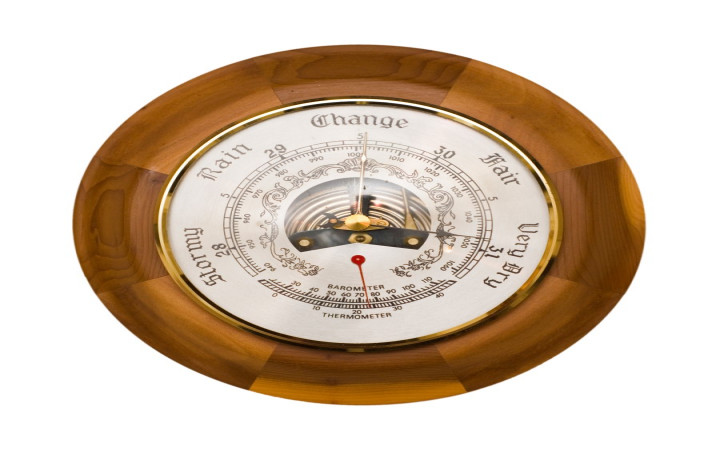
Can you feel the pressure? It’s around you… all the time… everywhere you go. What is it? Atmospheric pressure — often referred to simply as “air pressure” — is the constant force exerted on you by the weight of little particles of air.
These tiny air particles, called “air molecules,” can’t be seen, but they are all around you. They have weight, which means they constantly “push” down on you.
If you look straight up in the air, you can imagine a tall column of air above your head reaching all the way to the edge of the Earth’s atmosphere. The weight of that column of air is the amount of air pressure exerted on you.
If you move to a higher elevation (climb a mountain, for example), the air pressure will be lower. Why? The length of that column of air above you has decreased by the amount of your increase in elevation.
As you move to a higher elevation, you may notice that your ears have to “pop.” This balances the pressure between the inside and outside of your ear.
Since there are fewer air molecules the higher you go, you will also probably need to breathe faster to breathe in more molecules to make up for the deficit.
Air molecules also take up space. Because there tends to be a lot of empty space between air molecules, air can either fill a big area, or it can be compressed to fit into a smaller area. When it’s compressed, air is said to be under high pressure.
Earth’s atmosphere presses down on you with a force of almost 15 pounds per square inch. You may be wondering why it doesn’t feel that heavy or why you’re not crushed under the weight. Remember that thing you do called breathing?
The air inside your body balances out the pressure from air in the atmosphere, which prevents you from being squished by the pressure of the atmosphere. You don’t sense air pressure as a constant force because the air inside you balances outside pressure and you’re used to that feeling.
If you watch the weather report frequently, you’re sure to hear the meteorologist talk about barometric pressure. Weather forecasters use a special tool called a “barometer” to measure air pressure.
Barometers measure atmospheric pressure using mercury, water or air. You’ll usually hear forecasters give measurements in either inches of mercury or in millibars (mb). Forecasters use changes in air pressure measured with barometers to predict short-term changes in the weather.
Changes in air pressure signal the movement of high- or low-pressure areas of air called “fronts.” Air molecules in high-pressure areas tend to flow toward low-pressure areas.
We call this flow of air molecules “wind.” The larger the difference in pressure between areas, the stronger the winds will be.
As meteorologists monitor air pressure, falling barometer measurements can signal that bad weather is on the way.
In general, if a low-pressure system is on its way, be prepared for warmer weather with storms and rain. If a high-pressure system is coming, you can expect clear skies and cooler temperatures.


We were studying weather instruments in class!!
Wind vane
Barometer
Rain gauge
Thermometer
Anemometer
Wow,
! That’s a lot of weather instruments…thanks for sharing them! Looks like we might have some more weather Wonders in our future!
Love!!
Yippee, we’re so glad that you enjoyed our scientific Wonder, Timmari! Thanks!
What does a barometer measure also I love your website I cannot wait to use it again!
Hey there, Wonder Friend! Thanks for sharing your comment– be sure to check out our Wonder video and article to help you answer your question! We are glad you enjoy visiting Wonderopolis and we cannot wait to see you again!
Will do!
Thanks for responding, Wonder Friend F! We Wonder what you learned from our weather Wonder! Did you find the answer to your awesome question?
Yes I did and may I add you have such a good website that I am recommending to my friends!
Also, If you could have a video on sugar cane that would help a whole lot! <:)
Recommending always,
Wounder Friend F
P.S Please write back
HOORAY for you, Wonder Friend F! We are glad you’ve been spreading the Wonder with all your awesome friends! We don’t have a sugar cane Wonder to share with you right now, but we do have another sweet treat in the meantime: Wonder #159– How Do You Tap a Maple Tree? http://wonderopolis.org/wonder/how-do-you-tap-a-maple-tree/
What does a barometer measure in?
Great question, Wonder Friend! We are glad you’ve been thinking about the cool science of a barometer! Barometers are measured by inches in mercury, and the units are measuring barometric pressure!
Your website is wonderific!!!!!
Thank you so much, Wonder Friend F! We love your enthusiasm!
You’re Welcome!!! Do you have any videos about puppies?!?!?!
We’ve got a few Wonders about puppies and dogs, Wonder Friend F! Check these out:
#339– Where Do Wrinkles Come From? http://wonderopolis.org/wonder/where-do-wrinkles-come-from/
http://wonderopolis.org/?s=puppies
Thanks!!!!!!! Your comments always make me smile!
You are so kind, Wonder Friend F! You make us smile, too! Speaking of smiling, have you checked out Wonder #875– How Can You Make Someone’s Day? http://wonderopolis.org/wonder/how-can-you-make-someones-day/
No I have not but I will!!! And I bet it is as smile-riffic as the other videos!!!!
Very cool, Wounder Friend F! We hope you’ll check it out soon and let us know how you like it!
Well I saw it. It was so coo I could not stop smiling!!!!!! ( I LOOKED LIKE THHIS ————>
)
Well that sure is spectacular, isn’t it, Wounder Friend F?! We love to smile, too, it makes us very happy. We smile when we laugh, when we are excited, and even when we’re surprised! Isn’t it cool to think about all the different ways we express our emotions, Wonder Friend?
It sure is!!!!! Also can you tell me a little about body language???
Welcome back to Wonderopolis, Wounder Friend F!
Have you heard the saying “actions speak louder than words?” Sometimes we do means more than what we say. We can say kind things, and we can show kindness through a hug. Perhaps you can talk to your family or teacher about body language. How can you show kindness through words and actions?
Thanks for the help!!!!!!
You’ve got it, Wounder Friend F! We’re always happy to help and Wonder with you!
Good to know I can count on you!!!!
You’ve got it, Wounder Friend F! What are you looking forward to doing this summer?
I am looking forward to having a sleepover! Got any fun tips on it?????
You’re in luck, Wounder Friend F– check out Wonder #563 Do you Sleep at a Slumber Party? http://wonderopolis.org/wonder/do-you-sleep-at-a-slumber-party/
Thanks I watched it and it had some cool things in it!!!
We are SO happy that you liked this Wonder! Come back and hang out with us anytime, Wonder Friend F! Talk to you again soon!
Kk talk to you later (ttyl).
Hey there, Wounder Friend F! We love your comment, and we look forward to WWYL (WONDERing with you Later)!