

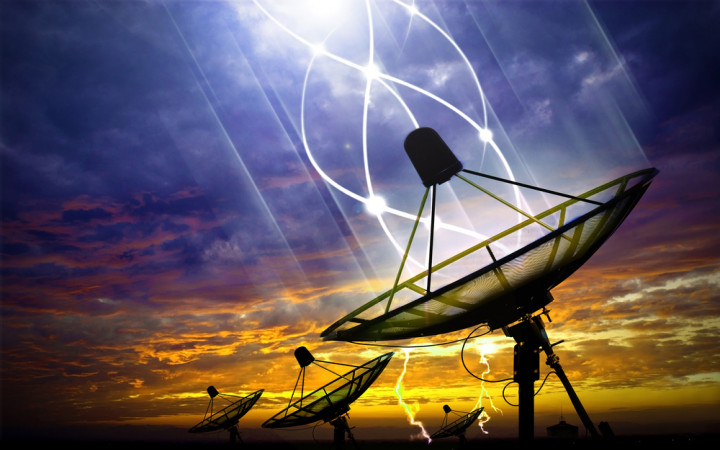
Without these things, our daily lives would look much different. Some of us couldn’t watch television. Some of us couldn’t figure out how to navigate from one place to another when traveling. Some of us could be endangered by bad weather that we didn’t know was coming. What are we talking about? Satellites, of course!
Satellites are any objects that revolve around (orbit) another object in space. Some satellites are natural, while others are artificial (man-made). The moon is an example of a natural satellite that orbits the Earth. We’re going to focus, though, on the man-made satellites.
Artificial satellites are machines that humans launch into orbit, usually around the Earth. Artificial satellites can be sent to orbit other planets, too. For example, the Hubble Space Telescope has been sent throughout space to orbit various planets.
The Soviet Union launched the first artificial satellite — Sputnik 1 — on October 4, 1957. The United States launched its first artificial satellite — Explorer 1 — about four months later.
Since that time, over 2,500 satellites have been launched into space. Would you have ever guessed there are that many satellites up there in the sky, traveling around the Earth over and over again?
What in the world do they do up there? Why do we need so many of them? Artificial satellites are used for all sorts of purposes. Satellites like the Hubble Space Telescope, the International Space Station and the Russian Mir space station help scientists explore space in new and exciting ways.
Communications satellites help us communicate with people all over the world. Weather satellites help us observe the Earth from space to help predict weather patterns. Radio and television satellites beam our favorite songs, movies and television shows to Earth for us to enjoy.
There’s even a group of 27 satellites that make up the Global Positioning System (GPS). Without these satellites, we couldn’t use the GPS devices to find our way while traveling.
If you’re wondering how that many satellites stay in orbit without bumping into each other, just remember that space is very…well…spacious! Compared to our measurements on Earth, the size of space seems infinite.
Even though there’s a lot of room in space, satellites are launched into orbits at different distances from Earth. Some may be as close as 150 miles above Earth, while others may be as far away as 20,000 miles or more.
Most artificial satellites orbit within 500 miles of Earth or what scientists call low-Earth orbit. These satellites have to travel very fast — about 17,000 miles per hour — to avoid being sucked back into Earth’s atmosphere.
Sooner or later, though, the force of gravity will pull all objects, including artificial satellites, back to Earth. When satellites quit working, they become orbiting “space junk” until gravity pulls them back to Earth. Although at least one piece of space junk returns to Earth every day, it’s rare that anyone ever notices. So no need to worry that the sky is falling!


(11 votes, avg. 4.27 out of 5)


Awesome.
We’re glad you think today’s Wonder is AWESOME, Rahul! We think YOU are AWESOME for being such a great Wonder Friend and leaving us comments each day!
I was wondering what do satellites do for us and how do they work.
That’s COOL that you were WONDERing just what today’s Wonder is about, Saad! Thank you for visiting Wonderopolis again today…we’re glad you’re here!
Wow, I had no idea how a satellite could do that.
We’re super glad you learned some great new stuff about satellites today, AH & KW! Thanks for visiting Wonderopolis!
I think tommorow’s wonder will be about dancing.
We think that’s a GREAT guess about tomorrow’s Wonder, Saad! Thanks for hanging out in Wonderopolis with us today!
WOW!!! I never knew satellites did so much!! REALLY cool!
We thought it was COOL to learn all about satellites today, too, Jaclyn! You’re a SUPER Wonder Friend…thanks for leaving us a comment today!
Can you do a wonder about. How do you make Easter Eggs, please!!!!!!!!!!!!!!!!!!!!
We hope you’ll visit Wonderopolis tomorrow, Heather…we think you will REALLY like Wonder of the Day® #553!
My class reads it at school. It is great.
Hello, Elinor! We’re glad you and your classmates visit Wonderopolis at school! We think that ROCKS!
Cool music , Fun.
Thanks for letting us know you liked the music for today’s Wonder, Kep! We appreciate hearing from you!
Hi Wonderopolis. I thought today’s wonder was really interesting and it was awesome seeing how a satellites goes into space. It was also cool that the video showed a real rocket taking off. My favorite part was when the satellite was separating in space. Bye.
;D
Thanks so much for sharing your favorite part of the video for today’s Wonder, Juliana! We’re super glad you stopped by Wonderopolis today and learned some FUN facts about satellites!
EPIC! I never knew the satellite is so cool and hard to build!
We thought it was really fun to learn about satellites, too, “D!” Thanks for hanging out in Wonderopolis today!
That was amazing!!! Do you know what they do when the satellites die???
That’s a SUPER question, John! When satellites stop working or “die,” they become “space junk” and rotate the globe until gravitational forces pull them back down to Earth! You can read more about space junk and satellites by exploring that highlighted “the sky is falling!” link inside today’s Wonder!
Are you going to have dogs on Wonderpolis?
Hi, Brandie! Thanks so much for letting us know you want to learn about dogs in Wonderopolis! We have some awesome DOG-related Wonders we think you might enjoy! Check them out:
Wonder #539 – Why Do Dogs Chase Their Tails? http://wonderopolis.org/wonder/why-do-dogs-chase-their-tails/
Wonder #491 – Do Dogs Really Eat Homework? http://wonderopolis.org/wonder/do-dogs-really-eat-homework/
Wonder #405 – Do Dogs Shop At Flea Markets? http://wonderopolis.org/wonder/do-dogs-shop-at-flea-markets/
That is so cool!
We’re SUPER glad you liked exploring this Wonder, Michael! Thanks for letting us know!
Satellites are awesome. How were satellites invented?
Ela and Calvin
That’s a REALLY super question, Ela and Calvin! We will all have to do some more WONDERing about that one! Thanks for visiting this Wonder and leaving us a comment today!
Wow, that was a little boring, but informing.
We appreciate your opinion of this Wonder of the Day®, Wonder Friend! Thank you for sharing it with us today!
I was going to give a link to this one realistic rocket launch game on ROBLOX. Sadly I cant find it.
That’s OK, Clayton! We’re really happy you left us a comment to let us know you visited this Wonder today! Thank you!
IT was COOOOOL!!!!!!!!!!!!!!!
We’re so glad you think so, Eli! Thanks for being a WONDERful Wonder Friend and learning new things with us today!
wow that is so cool
We’re glad you enjoyed it, Blondy! Have a WONDERful day!
I love you guys so much this so helpful. I have a project due tommorow and this told me everything I ever needed to know. P.S. Do you have anything else about satellites and what they can do?
We’re so glad that we could help you with your project, JollyJohn! We hope you did some research and WONDERing of you own, too! We want to make sure you’re writing down ideas and thoughts of your own, too! Thanks for sharing your comment and making us smile!