

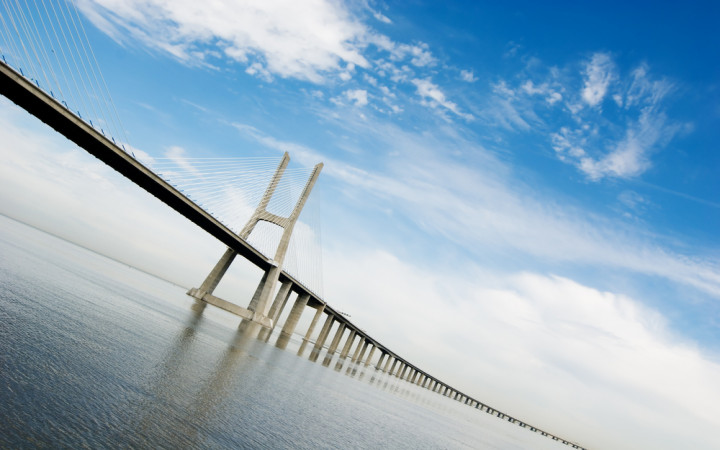
Can you imagine being an early explorer? Setting out to discover new lands, you couldn't predict what you would find. Sooner or later, you would surely run into rivers or other bodies of water that you would have to cross to continue your journey.
Early settlers who chose to make a home in a new area often had to decide where to live based upon the location of rivers and streams. Not only were these waterways sources of water, they also enabled settlers to travel to other areas.
To make travel between settlements separated by bodies of water easier, bridges were eventually built. Today, we take them for granted. But think about how much more difficult life might be if they didn't exist!
The first bridges were most likely simple logs placed over small streams. The science of engineering has come a long way since then. Now, bridges of many types are used to make it easier to cross over a variety of obstacles, including waterways, valleys, roads, and railroad tracks.
Believe it or not, there are over 500,000 bridges in the United States today. They come in a variety of lengths and styles, but they almost all fall into one of three basic types of bridges: beam, arch, or suspension bridges.
The main difference between the three types of bridges is what distance they can cross in a single span. A span is how far it is between bridge supports, which can be columns, towers or even the walls of a canyon.
Beam bridges consist of a horizontal beam (often concrete or steel) supported at each end by columns or piers. The weight of the beam and traffic on the bridge is directly supported by the piers. The farther apart the piers are, the weaker the beam will be. This is why beam bridges usually span no more than 250 feet. They're common on highway overpasses. Some beam bridges use supporting lattice work — called a truss — to add strength.
Arch bridges have great natural strength due to their shape. Semicircular in shape with abutments on each end, arch bridges are usually made of steel or concrete and can span up to 800 feet. The shape of arch bridges naturally distributes weight away from the center toward the abutments.
Suspension bridges use cables strung across tall towers to support the bridge surface, called the deck. Because the cables and the towers can distribute a tremendous amount of weight, suspension bridges can span from 2,000 to 7,000 feet! Almost all suspension bridges also have supporting truss systems underneath the bridge deck to add strength and support.
So how long are some of the longest bridges in the world? Because there are different ways to measure the length of bridges, a bridge can be the longest bridge in one of many categories. For example, China's Danyang-Kunshan Grand Bridge holds an elevated high-speed rail line and spans over 102 miles. China also is home to the world's longest sea bridge: the 26.4-mile Qingdoo Haiwan Bridge.

