

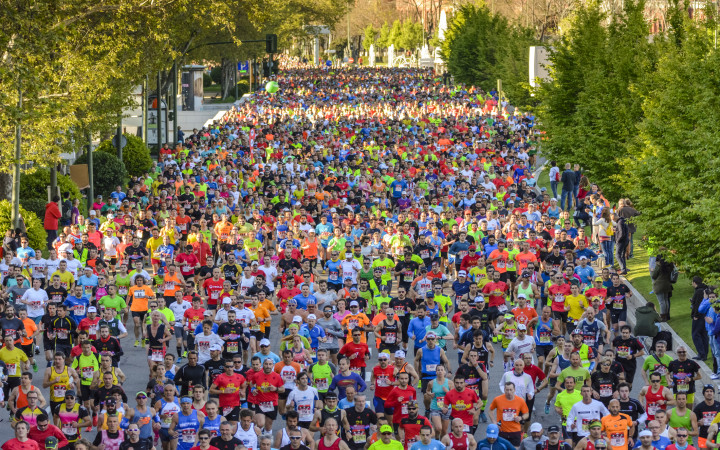
Today’s Wonder of the Day was inspired by Jackson. Jackson Wonders, “Why is a marathon exactly 26.219 miles?” Thanks for WONDERing with us, Jackson!
Have you ever come home from a “marathon" day at school? Maybe you've watched a movie marathon on television on a Saturday? Do you know someone who has participated in a dance marathon at some time in the past?
What do these “marathons" have in common? They're all contests, events, or happenings that were exceptionally long or required great endurance. They are all examples of the general use of the word “marathon."
Those who have run a marathon, though, know that the word has a special, specific meaning. For runners, a marathon is a running event — usually a road race — with an official distance of 26 miles and 385 yards (often abbreviated to 26.2 miles).
Marathons take their name from the legendary run of Greek soldier Pheidippides, who was a messenger during the Battle of Marathon. As the story goes, Pheidippides was sent from the battlefield of Marathon to Athens to tell everyone that the Greeks had defeated the Persians in the Battle of Marathon. Legend holds that Pheidippides ran the entire distance (approximately 25 miles) without stopping and exclaimed “We have won!" before collapsing and dying.
The marathon was featured as one of the original modern Olympic events in 1896. Since then, the men's Olympic marathon has traditionally been the last event, finishing inside the Olympic stadium, often as part of the closing ceremonies.
People often find it odd that a marathon is not a nice round number of miles. The International Amateur Athletic Federation (IAAF) set the standard distance for the marathon in May 1921.
Although the first seven Olympic Games featured marathons of six different distances (all between 24.85 and 26.56 miles), the IAAF settled on 26 miles and 385 yards, which was the distance used at the 1908 London Olympics.
The IAAF probably settled on the distance used during the 1908 Olympics because that race was widely considered to be one of the greatest races ever. It featured a dramatic finish that sparked a worldwide interest in the marathon.
Today, more than 500 marathons are run throughout the world each year. Most participants are recreational runners who do not run to win.
In fact, some are just happy to finish. Most runners simply compete against themselves, trying to beat their own personal best time.
Some runners try to break certain time barriers. For example, recreational first-time runners often try to run a marathon in less than four hours. Competitive runners may try to finish in less than three hours. Others might set a goal of qualifying for a major marathon.
Dennis Kimetto of Kenya holds the world record time for men at 2 hours 2 minutes and 57 seconds, set during the Berlin Marathon in September 2014. Paula Radcliffe of Great Britain holds the women's world record at 2 hours 15 minutes and 25 seconds, set during the London Marathon in April 2003.

