

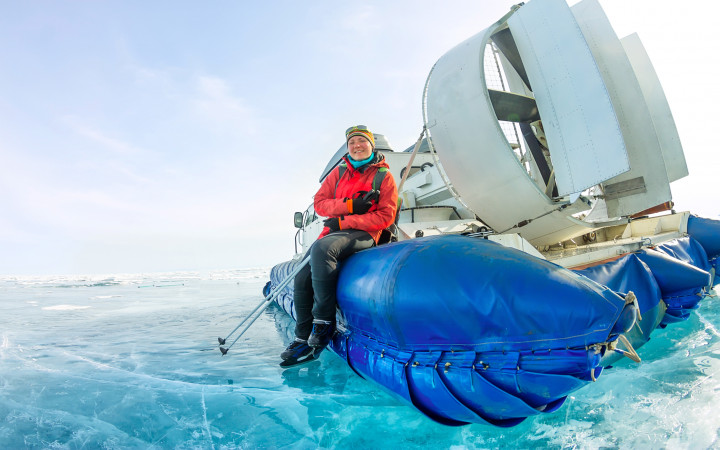
If you like science fiction movies, you’ve probably seen plenty of interesting space ships that hover and float about like magic. But did you know that there are real vehicles that can hover and travel over both water and land?
It’s true! We call these special vehicles hovercrafts. Hovercrafts are also sometimes called air-cushion vehicles or ACVs. Hovercrafts are known as amphibious vehicles, which means they can travel over both land and water.
Although hovercrafts can travel on both land and water, they’re more like airplanes than either boats or cars. They hover in the air on a cushion of pressurized air. Although it might sound like magic, it’s actually pure — and fairly simple — science!
Hovercrafts have engines that power fans. These fans blow air underneath the hovercraft to cause it to lift off of the ground. Depending upon the size of the hovercraft and the power of the engines, hovercrafts can lift from six inches to over seven feet into the air.
To help hovercraft engines work most efficiently, hovercrafts have skirts made of fabric surrounding their bases. These skirts help to keep the pressurized air from escaping.
To move, hovercrafts also need engine power to produce an air current that will push it forward. Some hovercrafts use two separate engines: one for thrust (forward motion) and one to create the pressurized air cushion. Other hovercrafts have one larger engine that produces a single air stream that is then split between thrust and cushion as needed.
Today, hovercrafts are used in many parts of the world for a variety of reasons. Because of their amphibious nature, hovercrafts are often used by military organizations to transport people and equipment over rough terrain. They can also be used to transport large groups of people across bodies of water rather than using boats.
The scientific principles behind hovercrafts were first demonstrated by Sir Christopher Cockerell in 1955. He built a crude object out of a cat food can, a coffee can and some kitchen scales. He also came up with the name “hovercraft.”


(13 votes, avg. 4.31 out of 5)


I was wrong!
That’s OK, Rahul! We REALLY appreciate how you like to guess what the next Wonder might be about…even if you’re not always 100% correct, we think you ROCK!
No!
I was wrong. Today’s wonder of the day is not about reading. However, I loved today’s wonder!
I think tomorrow’s wonder of the day is about Astronauts or about the planets.
I won’t be leaving another comment on Wonderopolis until Saturday, May 26, 2012.
Goodbye, Wonderopolis until Saturday, May 26, 2012!
TJ
That’s an AWESOME guess, TJ! We hope you have a WONDERful week at school and learn MANY new, cool, interesting things! You are a SUPER Wonder Friend and we really like your weekend comments…THANKS for sharing them with us!
It spins around on a boat I guess. Cool boat.
Hello, Levi! Thanks for visiting today’s Wonder of the Day® and learning some awesome new things about hover crafts with us! We think that’s WONDERful!
How do they go on water?
It looks fun!
It looked like it was flying in the beginning.
What a SUPER comment, Grace! We agree with you…it DOES look like fun! Hovercrafts have powerful engines that help create a cushion of air for the vehicle to move around on! Thanks for visiting today’s Wonder!
How did they get their name?
We’re not sure, Madyson, but we think it’s because they “hover” over the ground and water and also they’re “crafts” (vehicles). We appreciate your comment and THANKS for helping us WONDER more about hovercrafts today!
I think hovercrafts are cool, but my wonderopolis app for my iPod doesn’t show today’s yet about the hovercraft. It is still about the kaleidoscope.
Hovercrafts ARE cool, Mr. A., we agree! We’re sorry your app doesn’t show today’s Wonder yet. We bet it will pop up very soon! Thanks for letting us know, and THANK you for being a GREAT Wonder Friend!
Can you please make a wonder on does loch ness monster? Please, I beg you people of wonderopolis, please.
We think a future Wonder about the Loch Ness Monster sounds like a WONDERful idea, Rithik! Thanks so much for suggesting it! We hope you had as much FUN as we did learning about hovercrafts in Wonderopolis today!
Awesome.
We’re glad you thought today’s Wonder was AWESOME, Eric! Thanks for letting us know!
Cool, hover crafts are awesome. I wonder what would happen if you put those fans on a car.
That sounds like a fun invention idea, “Smile!” We’re glad you stopped by this Wonder of the Day® about hovercrafts and left us a comment to let us know you were here…THANKS SO MUCH!
How do hovercrafts really work because the hovercraft in the video looks like a boat and didn’t seem to hover at all?
I really want one so I can move to England!
Hi there Sawyer, that sounds pretty cool! We Wonder if you’ve ever been to England before?!
What would the future be like if hovercrafts were solar powered and could fly higher?!?!
What a great question, Wonder Friend B! We can’t predict the future, but we’re very proud of you for thinking about technology and hovercrafts– together they could do great things! Keep up the SUPER work!
I definitely will! I’m currently doing a science project on Hovercrafts and how they work and this is a GREAT wonder to teach me about it!
~Wonder Friend “B”
That’s awesome news, Wonder Friend B! We are so glad that you learned something new from our hovercraft Wonder… we bet your science project is going to be out-of-this-world amazing!
I am making a hovercraft big enough for a person to sit/stand on. Any tips on the project for me?
WOW, Wonder Friend B! That sounds like an impressive hovercraft! We want you to be safe when you’re building your very own hovercraft! How interesting that the first hovercraft was made out of only a few common things:
“The scientific principles behind hovercrafts were first demonstrated by Sir Christopher Cockerell in 1955. He built a crude object out of a cat food can, a coffee can and some kitchen scales. He also came up with the name “hovercraft.” ”