

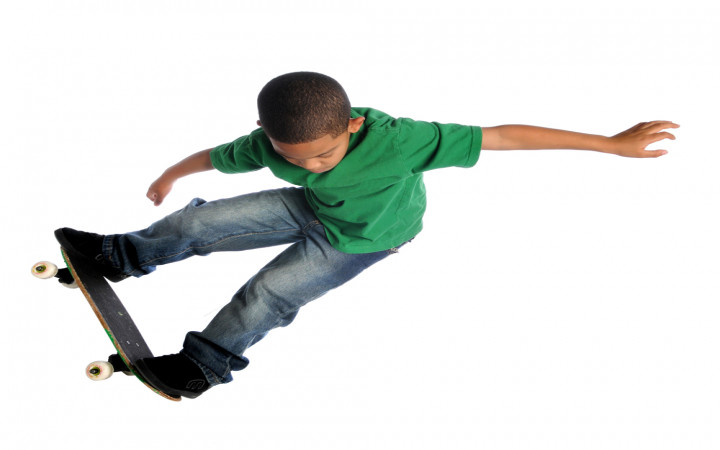
Today’s Wonder of the Day was inspired by christopher. christopher Wonders, “how to ollie” Thanks for WONDERing with us, christopher!
In 1976, skateboarder Alan “Ollie" Gelfand began performing hands-free aerial stunts with his skateboard. While doing tricks in empty swimming pools and custom-made skateboarding bowls, he would gently raise the nose of his skateboard and, with a scooping motion, take to the air, keeping the board at his feet the whole time.
Little did he realize that he had invented the “ollie," which would become one of the most well-known skateboarding tricks ever. A few years later, Rodney Mullen would take the ollie to the next level.
Using a see-saw motion, Mullen struck the rear of the skateboard on the ground to lift the nose and used his front foot to level the board. The result? An ollie performed on flat ground.
The ollie transformed the sport of skateboarding. Today, the ollie is a skateboarding fundamental.
It's often one of the very first tricks a skateboarder learns since so many other advanced tricks depend on the ability to ollie. Be warned, though: It can take a lot of practice to master the ollie!
The ollie is basically a jumping technique that skateboarders use to leap onto, over or off of obstacles. Skateboarders also often ollie over unfriendly gaps, like grass or stairs.
To those unfamiliar with skateboarding, the ollie looks like magic. Especially on flat ground, it's unclear to the naked eye exactly how the ollie works.
The skateboard seems to stick to the boarder's feet in mid-air, yet the boarder isn't using hands to hold it. How does this work?
The science of physics explains the ollie. As it turns out, it's all about manipulating the various forces involved in skateboarding.
When riding a skateboard, there are three forces at work on the board. The weight of the rider and the effect of gravity on the board itself both push downward.
Counteracting these forces is the force of the ground pushing up on the board. These forces balance each other, keeping the skateboard rolling along at a steady speed.
To do an ollie, the skateboarder crouches and then jumps upward quickly, raising the arms. While jumping, the boarder “pops" the rear — called the "tail" — of the skateboard by striking it against the ground. This action raises the front of the board.
When the tail of the board hits the ground, the ground exerts a powerful upward force. This causes the entire board to bounce and begin lifting up into the air.
As the board begins to rise, the boarder slides the front foot forward. The friction between the front foot and the board drags the board upward even farther.
The boarder then begins to push the front foot down while gently lifting the rear foot, leveling the board until the tail is even with the front of the board. This also helps to keep the tail in contact with the rear foot.
When the board is level at its maximum height, it — with its rider — will begin to fall due to gravity. As the board makes contact with the ground again, the boarder must bend the legs to absorb the impact of the landing.
It may look easy when you see it, but keep in mind that this all happens in a fraction of a second. With a lot of practice, skateboarders can ollie to even greater heights by learning to jump higher, pop the tail faster, slide the front foot farther forward and raise the legs even higher.
In case you're wondering exactly how high some skateboarders can ollie, the world records for different types of ollies usually exceed 40 inches, which is over 3 feet in the air! Rob Dyrdek holds the world record for the most consecutive ollies at 215.

