

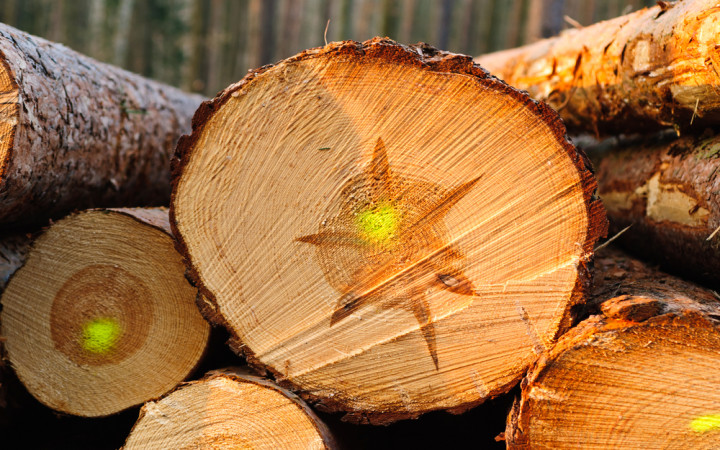
Today’s Wonder of the Day was inspired by Stacy from AL. Stacy Wonders, “How are trees made into paper” Thanks for WONDERing with us, Stacy!
Wood (pun intended!) you believe paper is made from trees? It's true! Let's take a look at how trees are turned into all sorts of paper.
If you look at a tree, you might have a hard time imagining how something so tall and strong could be turned into something as thin and weak as a sheet of paper. The process begins with the raw wood, which is made up of fibers called "cellulose."
The cellulose fibers are stuck together with a natural glue called "lignin." When the lignin is removed and the cellulose fibers are separated and reorganized, paper can be made.
It's also possible to make paper from a variety of other types of plant fibers, such as cotton, flax, bamboo, and hemp. For example, cotton fibers are often used to make the paper that money is printed on. The overwhelming majority (about 95 percent) of the raw material used to make paper, though, comes from trees.
To make paper from trees, the raw wood must first be turned into "pulp." Wood pulp is a watery “soup" of cellulose wood fibers, lignin, water, and the chemicals used during the pulping process.
Wood can be turned to pulp in a couple of different ways. Mechanical pulping involves using machines to grind wood chips into pulp.
The resulting pulp retains most of its lignin, though. The short fibers created by grinding leads to weak paper most suitable for newsprint, phone books, or other types of low-strength papers.
The more commonly used method is chemical pulping, also known as “kraft." Chemicals are used to separate lignin from the cellulose fibers, leaving a pulp mixture that can make stronger papers.
Depending on what type of paper is desired, the pulp mixture might need to be bleached to create whiter paper. Papermakers use a variety of chemicals to bleach pulp to the color they want.
Once the pulp is ready, it is then used to make paper in a process that is quite similar (in the basic actions) to the process first used by the ancient Chinese more than 1,900 years ago. Because the pulp mixture is so watery (sometimes as much as 99 percent water!), the cellulose fibers need to be separated from the watery mixture.
Huge machines spray the pulp mixture onto moving mesh screens to make a layered mat. The mat of pulp then goes through several processes to remove water and dry it out.
Finally, the mat is run through heated rollers to squeeze out any remaining water and compress it into one continuous roll of paper that can be up to 30 feet wide.
When the paper has the desired thickness, it may be colored or coated with special chemicals to give it a special texture, extra strength, or water resistance. As a last step, the paper rolls are cut to size and packaged for shipping to other facilities for additional processing to turn it into all sorts of specialized papers.

