

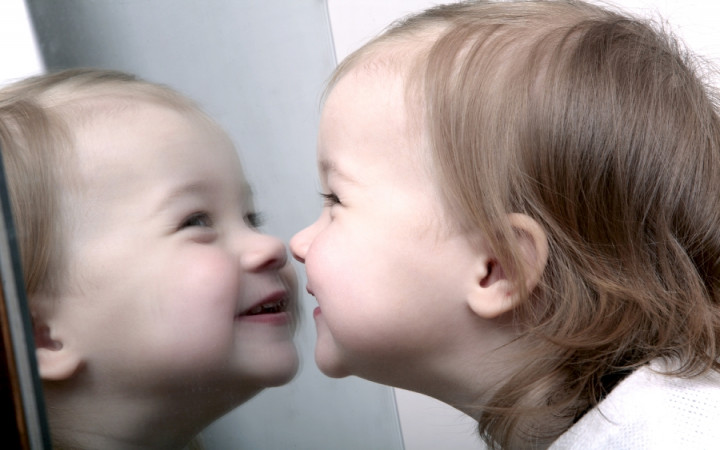
Would you believe that mirrors have been around since the beginning of time? It’s true! The first human beings ever to look into a calm, dark pool of water saw their reflections.

Don’t you wonder what their reactions were? Who are those people? And what are they doing in the water?!

Basically, anything with a smooth surface that reflects almost all of the light that hits it — with only very little light absorbed or scattered — can be a mirror. The key factor is a smooth surface because rough surfaces scatter light instead of reflecting it.

When photons — rays of light — coming from an object (your smiling face, for example) strike the smooth surface of a mirror, they bounce back at the same angle. Your eyes see these reflected photons as a mirror image.

The mirror image is reversed, which you can easily see if you stand in front of a mirror with a shirt with words on it. The words on the shirt appear backward in the mirror.

Of course, not all smooth surfaces act as mirrors. If a smooth surface absorbs the photons, they can’t bounce back, and there will be no reflection.

Although calm, dark water has been used as a mirror since the beginning of time, people started making mirrors thousands of years ago. The first mirrors were likely polished stones, such as obsidian (a type of volcanic glass). Large pieces of polished metal, such as brass, were also used as mirrors, although these were very expensive.

The modern mirrors you’re familiar with are much more recent. European glassmakers began developing a process of coating clear glass with a thin layer of reflective metal in the 15th and 16th centuries.

Today, mirrors are usually made of clear glass that has been coated on one side with a thin film of metal, such as silver or aluminum. The mirrors in most bathrooms are these types of mirrors, known as “plane mirrors.”

They are flat and reflect the objects in front of them accurately, maintaining the same relative size and position of the objects reflected.

In addition to helping you make sure your hair looks nice before you head out to school or off to work, mirrors serve many important functions. For example, rear-view mirrors on a car allow you to see what’s behind you before you back up. Mirrors are also important parts of telescopes and microscopes.

Mirrors can even help you watch television. Today’s high-definition televisions often rely on millions of microscopic mirrors to display those beautiful, crisp images you enjoy watching so much!


4 Join the Discussion

1 Star2 Stars3 Stars4 Stars5 Stars  (6 votes, avg. 3.67 out of 5)
Loading ... Loading ...
  1. It’s not as simple as you make it seem. Light is composed of photons, yes, but it behaves like a wave. Photons interact with electrons (causing the electrons to jump a level producing a new a photon when they fall back. A photon that hits a black surface will still cause an electron to jump, but the wavelength of the new photon will be in the infrared region, AKA heat; it is not “absorbed”. It is the wave-like behaviour of photons that cause mirrors to work. Without the waves, no image reflection can take place. This is also true in optics, in which light is refracted – different wavelengths are refracted at different angles, such as in a spectrometer.
    Anyway, otherwise a good piece!
    Thanks, David

    • Thank you SO MUCH for sharing your expertise on mirrors and adding something extra special to this Wonder of the Day®, David! We appreciate it when our Wonder Friends add on to the Wonders by providing even more interesting information…it makes us all a little smarter! Thank you for visiting Wonderopolis today! :-)

Leave a Reply

Your email address will not be published. Required fields are marked *

You may use these HTML tags and attributes: <a href="" title=""> <abbr title=""> <acronym title=""> <b> <blockquote cite=""> <cite> <code> <del datetime=""> <em> <i> <q cite=""> <strike> <strong>

Share

  • Wonderopolis on Facebook
  • Wonderopolis on Pinterest
  • Print

Have you ever wondered…

  • How do mirrors work?
  • What are mirrors made of?
  • Have mirrors always been made of glass?

Wonder Gallery

young girl in veil_shutterstock_22588852Vimeo Video

Try It Out

Ready to have some fun with mirrors? For today’s fun activities, you’ll need to find a couple mirrors to use. Make sure you get permission to use a mirror if it belongs to someone else.

You may not realize it, but mirrors can be super-secret spy tools for secret agents. It’s true! To start, you’re going to learn how to use a mirror to compose a secret message in mirror code.

Think of a short message you want to deliver to some friends. Write it out in large letters on a piece of paper. Then, hold your message up to a mirror.

When you look at the reflection of your message in the mirror, it should look kind of funny. Take another piece of paper, and copy your message the way it appears in the mirror.

Take your time. This can be harder than it sounds. When you’re finished, give your “coded” message to your friends.

Can they read it? Probably not! Give them a clue that they may need a mirror to decode your message. Once they understand the trick, ask them to compose a message in mirror code for you to decode.

When you’re finished with your mirror messages, use mirrors to explore the world around you in ways you don’t normally see it. You can use mirrors to see sides of things you rarely see.

What does it look like underneath a car? Hold a mirror under a car and check it out!

What about the underside of an ant or another bug? Find some bugs and put them on a mirror. Isn’t it strange to see things from a new perspective?

What other interesting views can you get with mirrors? Enjoy exploring the seldom-seen side of things!


Still Wondering

Can you always trust what your eyes see in a mirror? Check out Science NetLinks’ Changing Illusions tool for an interactive resource that contains five illusions.


Wonder Categories/Tags

Categories

Tags

image  light  mirror  photon  ray  reflection 

Wonder What’s Next?

Tomorrow’s Wonder of the Day features a must-have craft for all your BFFs!

Upload a Photo or Paste the URL of a YouTube or SchoolTube Video.