

The word “petrified” comes from the Greek word petro, which means “rock” or “stone.” Around Halloween, you may hear people say they’re petrified.
They mean they’re very scared of something — scared enough that they’ve turned to stone and cannot move! If you ever find yourself petrified, you may be standing as still as a tree in a petrified forest.
Petrified wood is what scientists call the fossilized remains of trees that have turned into stone through a process called “permineralization.” This process occurred underground when, millions of years ago, wood became buried under sediment (like mud).
Sediment initially preserves the wood by insulating it from oxygen, which usually starts the decomposition process. Over time, all the organic (living) materials in the wood slowly decay and are replaced with minerals. These minerals are usually silicates (like quartz).
Water with these minerals flows through the sediment. As it does so, it deposits minerals in the wood’s cells. The wood’s plant cells decay, and a stone mold forms in their place.
Petrified wood is different than other types of fossils. Most fossils are impressions or compressions.
Petrified wood, on the other hand, is a three-dimensional fossil that retains the original structure of the wood.
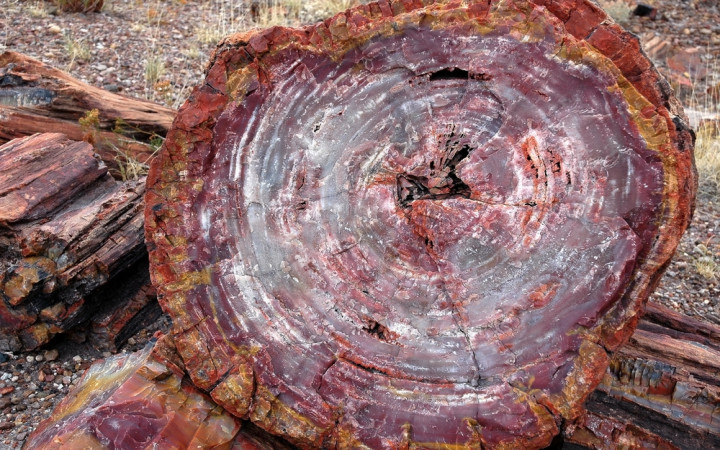
Petrified wood gives scientists great insight into plants from millions of years ago. In fact, minute details, like tree rings, can often be seen in great detail.
Scientists believe that wood can become petrified in less than 100 years. Areas with large amounts of petrified wood become known as petrified forests.
Many examples of petrified wood contain a wide variety of bold, beautiful colors. Although pure quartz crystals are colorless, other elements — including manganese, iron and copper — often find their way into sediment during the process.
These “contaminants” can give the resulting petrified wood many interesting colors, including black (carbon), blue (cobalt), green (oxidized copper), red (iron), yellow (manganese oxide) and pink/orange (manganese).
Petrified forests can be found all over the world. Some of the most famous sites in the United States include Petrified Forest National Park in Arizona, Petrified Wood Park in South Dakota, Mississippi Petrified Forest in Mississippi and Escalante Petrified Forest State Park in Utah.


(3 votes, avg. 4.67 out of 5)


Hi, Wonderopolis. I don’t think trees get scared, because trees can’t move or talk and trees don’t have any feelings.
You’re right about trees not having feelings and not being able to move on their own, Ruthie! We WONDERed how wood becomes petrified, so we thought it would be fun to ask if trees get scared (petrified)? We hope you learned as much as we did about petrified wood from exploring today’s Wonder of the Day®!
Hmm…so trees can get scared, cannot get scared, and can scare people. That Is a really cool WONDER! Does this have anything to do with the tree’s rings when you cut it and you can tell how old it is?
Hi again, Nitnik! Thanks for leaving us another awesome comment on today’s Wonder of the Day®! Since petrified wood is a three-dimensional fossil, you can actually see the tree rings you are talking about even though they are millions of years old! We don’t think there are millions of tree rings on a slice of petrified wood, though, because once the tree stops growing, it stops making the rings.
I never knew trees had feelings.
Trees don’t really have feelings, Zaid! When we say they are “petrified,” we are actually talking about a very, very long process called “permineralization” that turns them from wooden trees into rock fossils! Thanks so much for visiting today’s Wonder!
No, because trees cannot move and do not have feelings or talk.
Hi, Tyler! Thanks so much for hanging out in Wonderopolis today and for leaving us a comment! We hope you learned a lot about petrified (fossilized) wood from exploring this Wonder of the Day®!
I think trees are not scared, because they can’t move or sprek.
Thanks so much for leaving us a comment and for letting us know you visited today’s Wonder about petrified wood, Munira! We hope you learned some new things today!
I like the fact that contaminants can make interesting colors on petrified wood.
Hi, Leigha! Thank you for letting us know what you enjoyed learning from this Wonder of the Day®! If you have some extra time today, we think you might also like exploring past Wonder #317 about how different types of colored glass are made! Here’s a link: http://wonderopolis.org/wonder/how-do-you-color-glass/.
AWESOME!!!!!!! I love this wonder! Do you have any wonders about cheese? THANKS!!!! BYE!!!!
Hi there, Missy! You bet we have some Wonders about CHEESE! Check these out when you get some time:
Wonder #52 – Why Is Cheddar Cheese Orange? http://wonderopolis.org/wonder/why-is-cheddar-cheese-orange/
Wonder # 322 – Why Are Some Cheeses Stinky? http://wonderopolis.org/wonder/why-are-some-cheeses-stinky/
Thanks for visiting Wonderopolis today and for leaving us another GREAT comment!
Who likes cheese other than this guy? IIIIIIIII’mmmmmmm CCCCCRRRRRAAAAAAAZZZZYYYYY FFFOOORRR CCCHHHEEESSSEEE!
We’re happy to hear that you like cheese, Tre’von! Did you know that there are Wonders of the Day about CHEESE? Here they are with links that will take you right to them!
Wonder #322 – Why Are Some Cheeses Stinky? http://wonderopolis.org/wonder/why-are-some-cheeses-stinky/
Wonder #52 – Why Is Cheddar Cheese Orange? http://wonderopolis.org/wonder/why-is-cheddar-cheese-orange/
We hope you have fun learning more about something you’re crazy about…CHEESE!
Very interesting. We all learned something new today!
It makes us VERY HAPPY to hear that, GRADE 2/3 SFES! We really enjoy hearing from our Wonder Friends…THANK YOU for your comment today!
Hi, everyone! We hope you liked the AWESOME video for this Wonder as much as we did!
We wanted to let you all know that the video was created, filmed, and edited by a very talented Wonder Friend from Germany named Ulrich Weigel!
That’s a great question to ask everyone, and a mysterious one, wonderopolis. I liked this one. Thanks for the great wonder, wonderopolis. I loved it, but I think it’s kind of a silly one to ask everyone, because everyone knows trees don’t have feelings like human beings do. We’re special that we have feelings.
You’re right, Rida! Human being are special because we have feelings. We weren’t trying to trick anyone with our Wonder question…we were hoping to get our Wonder Friends to WONDER about trees being petrified! Thank you for letting us know what you thought about this Wonder! We really appreciate your comment and your opinion!
I think trees can get scared they’re like people but they can’t move or talk.
=)
We think you make a great point, Chuchin! It’s so great to know that you’re WONDERing with us today– keep up the SUPER work!
You know technically trees can move, and I think trees do get scared and happy and restless, they talk in their own way, very silently but they talk, you just have to know when to see it.
How creative, Parker, we think it’s cool that you used your creative imagination to share your comment with us! Trees are very cool, and we think they have character, too! We bet you could write an awesome poem or story about trees, Parker! Keep up the great work!