

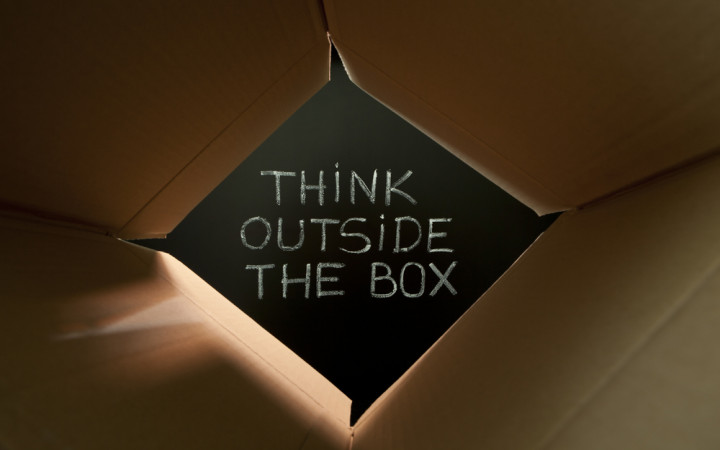
Is the phrase “think outside the box” really about a box? Not exactly, but this phrase is commonly used to encourage people to think creatively.
Basically, it means to think about things in a new or uncommon way. “Inside the box” would be the typical way to think — responding in a typical, usual or expected manner.
It’s typical to respond to the gift inside a box. But sometimes, as you probably know, playing with the box itself can be just as fun as playing with the new toy it contained.
Cardboard boxes are quite versatile. They are used every day to package and ship millions of different types of goods.
Although most people have an idea of what a “cardboard box” is, the term “cardboard” can actually be used to describe a wide variety of heavy paper-based materials. Two of the most common types of “cardboard” are paperboard and corrugated fiberboard.
Robert Gair invented the precut paperboard box in 1890 by accident. Gair was a printer and paper bag maker in Brooklyn, New York.
One day, while printing seed bags, a metal ruler he used to crease bags slipped and cut them instead. Gair realized that, if he cut and creased in one step, he could make prefabricated paperboard boxes.
Paperboard boxes really took off with the invention of flaked cereals, such as corn flakes. In fact, the Kellogg Company was the first to use paperboard boxes as cereal cartons.
What most of us think of when we hear “cardboard box” is actually a material called “corrugated fiberboard.” Corrugated fiberboard is made of corrugated (also called “pleated” or “fluted”) paper combined with one or two flat linerboards.
Separately, the parts of a cardboard box are just weak paper materials. Combined, though, they transform the weaker pieces into a rigid material suitable for packaging, shipping and protecting a wide variety of delicate goods.
Corrugated paper was patented in England in 1856, where it was used as a liner for tall hats. It was not used for packaging and shipping, however, until several years later. On December 20, 1871, a patent was issued to Albert Jones of New York City for single-sided corrugated board.
In 1874, G. Smyth invented a machine that could produce mass quantities of corrugated board. That same year, Oliver Long invented corrugated board with linerboard on both sides, which is the corrugated cardboard we’re familiar with today.
Corrugated cardboard manufacturing in the United States began in 1895. By the early 1900s, corrugated cardboard boxes had started to replace wooden crates as shipping cartons.
Today, the packaging and shipping of a single product is only the beginning of life for most corrugated cardboard boxes. In addition to being recycled into new boxes, many cardboard boxes are reused in a variety of ways, from sleds and children’s toys to costumes and school projects.
Many parents often joke that their kids, when given an expensive present, enjoy the box it came in as much as the present itself. Sometimes it’s true. Cardboard boxes, when combined with imagination, can be used in an almost-infinite number of ways.
Cardboard boxes enjoy a long, well-earned reputation as toys. In fact, in 2005, a cardboard box was added to the National Toy Hall of Fame. It’s one of only a few non-brand-specific toys featured there.


(11 votes, avg. 4.91 out of 5)


Hmmm… A sinking feeling about the Titanic?
That’s a GREAT guess, Rahul! We’ll have to check back tomorrow to see if you were right! Thank you for “thinking outside of the box” with us today!
When I served as the Florida Department of Education state consultant for gifted education, I was asked to provide technical assistance to school districts regarding strategies for identifying and improving creative thinking skills, or “thinking outside the box.” Just wanted to share a few of these strategies:
Fluency is the ability to think of many answers to a question, to list many possible solutions to a problem, or to generate a number of responses. Fluency is being able to think of lots of plans or ideas. You are fluent when you can:
Think of a long list of reasons for…
Make a very long list of…
List many uncommon uses for…
Flexibility is the ability to change your way of thinking about a problem or situation. It is the ability to think of alternative ideas and to adapt to different situations. You are flexible when you can:
Think of an alternative to…
Think of another way to…
Invent an interesting way to…
Originality is the ability to think of fresh or unusual designs, ideas, responses, or styles. People who are original are independent and creative in their thoughts and actions. They create things that are new, different, or unique. You are original when you can:
Suggest a unique name for…
Devise a tool that will help…
Design a…
Elaboration is the process of expanding an idea by adding detail. To elaborate, you must understand the original idea and see a way to clarify or improve it by adding specific details. You are elaborating when you add to, enlarge, enrich, or expand descriptions, designs, drawings, explanations, instructions, reports or stories. You are using elaboration when you can:
Add extra details to…
Tell more about…
Explain the instructions to…
Thank you for adding such WONDERful information to this Wonder of the Day® about creativity, Beth! We really learned a lot from your comment!
I think it’s going to be How Volcanoes Were Made.
That’s another AMAZING guess, Vikkie! We’ll all have to visit tomorrow’s Wonder to find out if you were correct!
I think thinking outside the box is thinking and applying your skills to a higher level than what is expected. For example, if your teacher tells you to write a detailed 4 paragraphed story, you write 6 and very detailed and in depth. Shout out to my school, Bay Lane Middle School, you guys rock and we always think outside the box!
What a REALLY AWESOME comment, Paige! We like your definition of “thinking outside of the box!” We also like the pride you take in your school and how you encourage your classmates…way to go!
Thank you wonderopolis! Yeah, I love my classmates and a shout out to my BFF Katie! I love wonderopolis!
We think you are a WONDERful Wonder Friend, Paige!
The “box” contains usually social expectations and strict definitions of roles. Thinking and living within the boundaries of the box gives one a “false” sense of security and belonging. It becomes one’ s comfort zone. Leaving that comfort zone, once in a while, is like thinking outside the box. Transcending the limiting boundaries of the box, one discovers new self-frontiers, new creativity, a new level of self not known to her/him before.
Thanks for such ”out of the box” questions!
Thanks so much for visiting this Wonder of the Day® and for sharing your thoughts on what “thinking outside of the box” means, Fatinah! We appreciate your comment very much!
I never knew a kid could have so much fun with an empty box! I thought the baby would leave the box, but it didn’t. But I wonder(opolis) why the baby never left the box (thought outside the box?)?
We like the way you WONDER, Zev! We’re pretty sure that the baby doesn’t know how to “think outside of the box” yet, because it is really young. We bet it will be a creative thinker like you when it gets a little older, though! Keep WONDERing, and THANKS for being a Wonder Friend!
Thanks for the WONDERful inspiration!